

Healthcare decisions begin long before a patient walks through your doors.
With 7% of all Google searches now focused on health, people are actively searching for answers, comparing providers, and shaping their choices online.
Search traffic sends three times more visitors to hospital websites than any other source. That means your digital presence is the front door to your brand. Whether someone needs a routine checkup or urgent care, their journey often starts with a search bar.
These healthcare marketing statistics reveal what is working, where attention is shifting, and how smart strategies are driving real results. Every stat is verified and sourced from trusted data, listed clearly at the end of the article.
If you want to stay relevant, connect more quickly, and grow stronger, this is the data that can propel your marketing forward.
1. The global healthcare market will reach $665.37 billion by 2028.
(Insider Intelligence)

This growth reflects increasing demand for healthcare services, driven by factors such as an aging population and advancements in medical technology.
As you consider your marketing strategies, it’s crucial to recognize how these trends impact patient behaviors and expectations.
2. Approximately 7% of all Google searches are health-related.
(NYT Licensing)

Millions of people turn to the Internet every day to seek health information. Your organization can leverage this data by optimizing your online presence to attract these visitors.
This statistic shows the importance of tailored content and strategic online marketing in healthcare.
Whether through blogs, informative articles, or engaging social media posts, ensure your content resonates with those searching for health-related topics.
3. Global healthcare spending is forecasted to reach $15 trillion by 2029.
(Statista)
This increase represents a substantial investment in healthcare resources, technology, and services, driving the demand for effective marketing strategies.
As a healthcare marketer, you should be aware of the implications of this growth. Increased spending opens opportunities for targeting specific consumer needs, enhancing patient engagement, and leveraging technological advancements.
Utilizing data-driven marketing strategies can help you connect with consumers as their expectations evolve in this expanding market.
4. U.S. national healthcare expenditures reached $4.5 trillion in 2022 and are estimated to reach $6.2 trillion by 2028.
(CMS.Gov)
This anticipated increase is due to several factors, including an aging population and advancements in medical technology.
You can leverage this information to create targeted campaigns that address patients’ specific needs and preferences, ultimately enhancing patient engagement and loyalty.
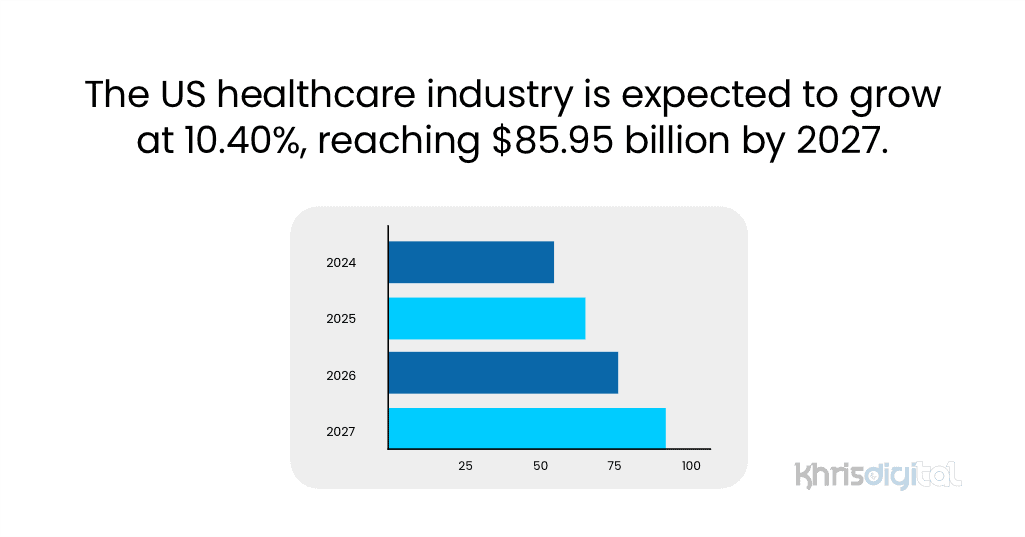
5. The US healthcare industry is expected to grow at 10.40% CAGR, reaching $85.95 billion by 2027.
(Statista)
As this industry evolves, innovative technologies and services are likely to reshape patient experiences.
Increasing competition among healthcare providers will make it essential to adopt practical marketing approaches. Marketing efforts will focus on traditional outreach and leveraging digital platforms for broader reach.
6. U.S. healthcare advertising will grow to $29.2 billion in 2028.
(Adfire Health)

This increase reflects a compound annual growth rate of approximately 4.6%. As more healthcare organizations recognize the importance of effective marketing strategies, investment in advertising becomes essential for staying competitive.
7. Healthcare online ad spend in the U.S. is roughly $17 billion.
(Statista)
You may notice that healthcare organizations are leveraging various channels, including social media, search engines, and display ads, to reach their audiences.
This approach enhances visibility and effectively allows targeted marketing efforts to drive engagement and conversion.
8. The average cost for an organic healthcare lead is $320.
(First Page Sage)