

Artificial intelligence is quietly reshaping the retail world, not just with futuristic tech, but with real, measurable impact.
And the shift isn’t small. The AI in retail market is projected to reach $40.74 billion by 2030, growing at a 23% CAGR between 2025 and 2030.
From how products are stocked and priced to how shoppers discover and buy them, artificial intelligence quietly reshapes the entire industry.
And by 2035, AI is expected to boost retail efficiencies by a massive 59%.
What used to be guesswork is now powered by data. What used to take hours can happen in seconds.
This is happening, and the numbers prove it. Below, you’ll find verified, up-to-date, and trustworthy AI in retail statistics that reveal how deeply AI is embedded in the retail world, with a full list of reliable sources at the end.
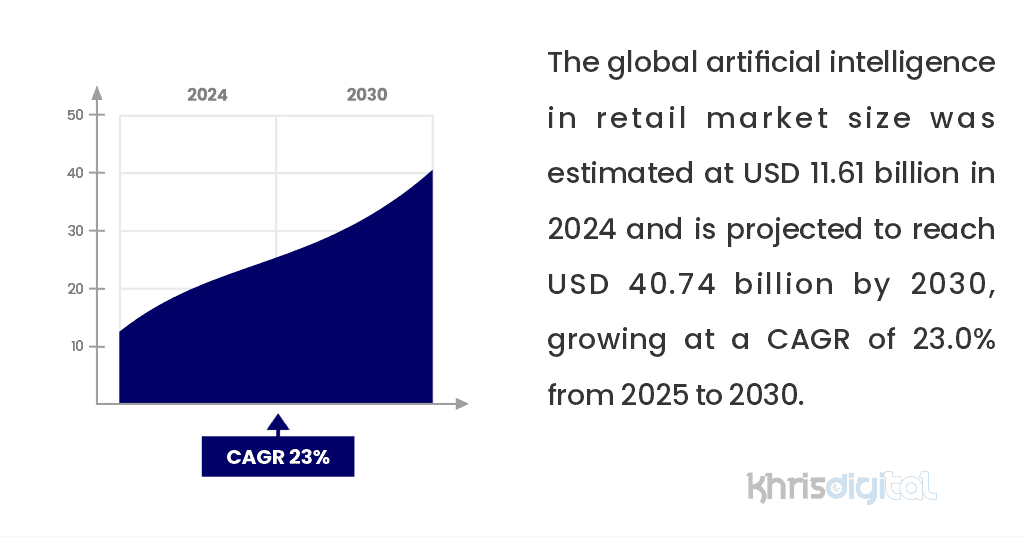
1. The global artificial intelligence in retail market size was estimated at USD 11.61 billion in 2024 and is projected to reach USD 40.74 billion by 2030, growing at a CAGR of 23.0% from 2025 to 2030.
(Grand View Research)
The retail industry is investing aggressively in AI to stay competitive. From dynamic pricing to real-time inventory tracking, retailers are embedding AI into almost every layer of their operations.
The projected growth rate reflects not just interest but actual adoption, fueled by pressure to improve margins and customer experiences. Larger chains are scaling AI initiatives faster, while smaller players are catching up through third-party platforms.
This surge is also driven by rapid advancements in generative AI, computer vision, and predictive analytics. As AI shifts from experimental to essential, the market value is following suit.
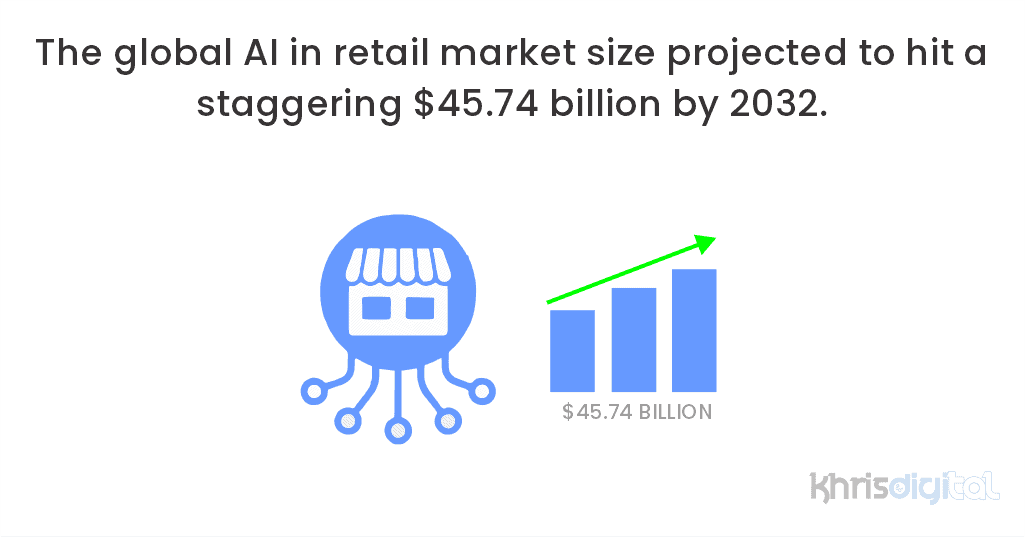
2. The global AI in retail market size projected to hit a staggering $45.74 billion by 2032.
(Neontri)
This projection shows that AI’s role in retail isn’t peaking anytime soon. As adoption grows, so does the demand for smarter systems that can handle everything from automated checkout to customer sentiment analysis.
More retailers are shifting budgets from traditional tools to AI-first platforms, especially in areas like fraud detection, chatbot support, and demand forecasting.
3. The global AI in retail market size is projected to surge to $62.64 billion by 2034.
(Precedence Research)

As systems grow smarter and integration becomes more seamless, AI is expected to move from back-end support to customer-facing experiences at scale.
Tools that were once experimental, like virtual try-ons, AI-driven supply chains, and autonomous stores, are becoming mainstream. Retailers are also forming dedicated AI teams to innovate faster and respond to shifting consumer behavior.
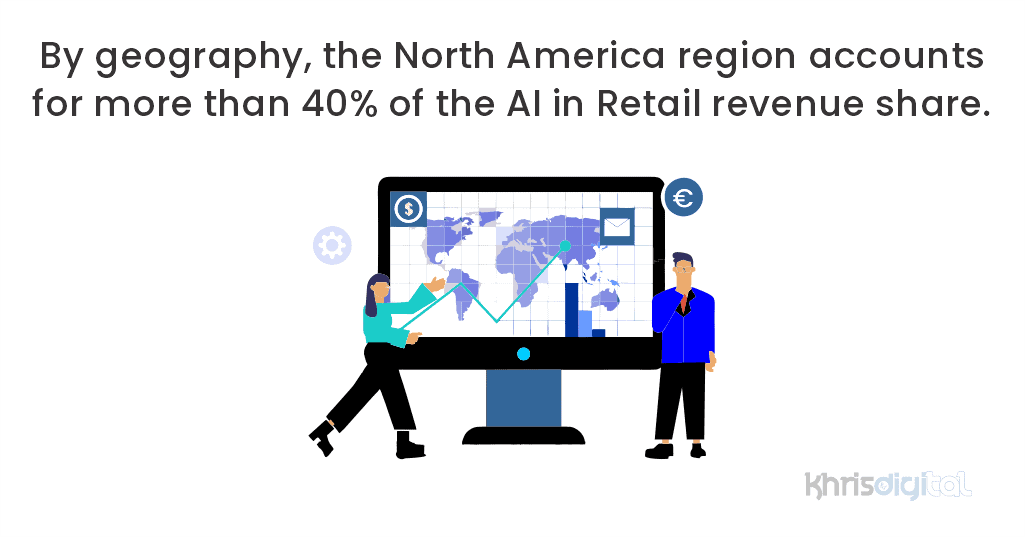
4. By geography, the North America region accounts for more than 40% of the AI in Retail revenue share.
(Precedence Research)
North America’s dominance in AI retail revenue reflects both early adoption and aggressive investment. Major U.S. and Canadian retailers have led the charge by embedding AI into supply chains, customer analytics, and omnichannel strategies.
The region also benefits from close proximity to leading AI research hubs and tech companies that build retail-focused solutions. Retail giants are setting the pace, but mid-size and niche players are also expanding their use of AI.
5. By segment, the solution segment accounted for more than 72% of the AI in retail revenue share.
(Precedence Research)
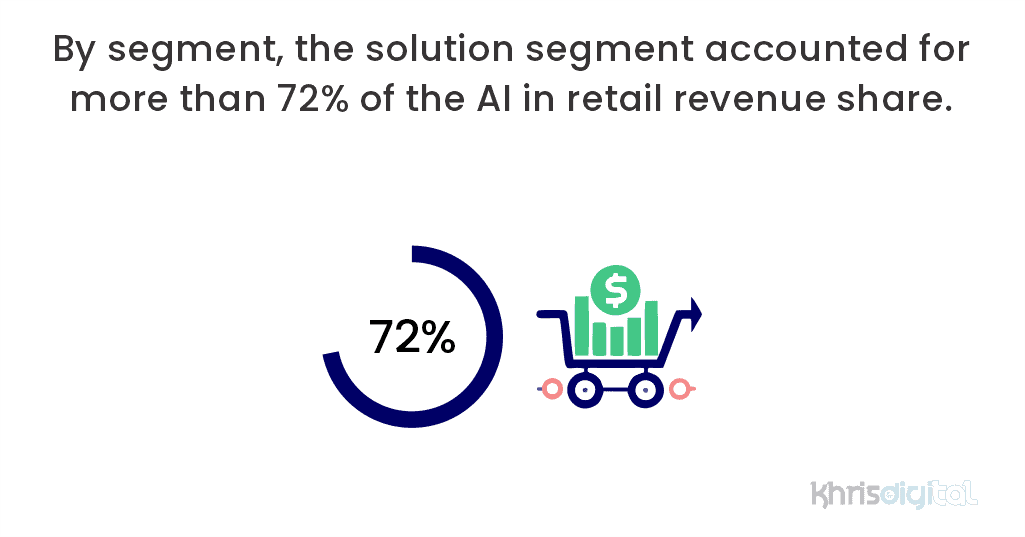
Solutions dominate because that’s where retailers see immediate value. AI-powered tools like recommendation engines, demand forecasting systems, and visual search features are being rapidly deployed to improve both backend efficiency and customer-facing experiences.
Most companies prefer ready-to-use or customizable AI software over building in-house systems, which shortens deployment time and lowers risk.
6. In terms of technology, the machine learning segment accounted for more than 31% of the AI in retail revenue share.
(Precedence Research)
Machine learning leads because it powers some of the most impactful applications in retail today. From forecasting demand to optimizing pricing, ML algorithms help retailers make smarter, faster decisions using real-time data.
This segment has gained momentum as more businesses move away from gut-based decisions and toward data-driven operations. ML models constantly improve with more inputs, giving companies a growing edge over time.
7. By sales channels, the pure-play market segment gained a sizeable revenue share.
(Precedence Research)
Pure-play retailers, operating entirely online, are often the first to adopt and scale AI. With no physical storefronts to maintain, their focus is fully digital, making it easier to integrate AI into every customer touchpoint.
These brands rely heavily on recommendation engines, personalized search, automated customer service, and dynamic pricing to stay competitive. Since data is at the core of their operations, AI fits naturally into their growth strategies.
8. By application, the customer relationship management segment accounted for around 21.50% of the AI in retail revenue share.
(Precedence Research)
Retailers are heavily leaning on AI to improve how they manage and maintain customer relationships. With shoppers expecting faster, smarter, and more personalized interactions, AI-driven CRM tools are becoming essential.
These systems track behavior, predict needs, and automate communication in ways traditional CRMs can’t match. AI helps brands send the right message at the right time through the right channel, whether it’s an offer, a reminder, or product recommendations.
9. The U.S. artificial intelligence (AI) in retail market size was estimated at USD 3.26 billion in 2024 and is predicted to be worth around USD 18.19 billion by 2034, at a CAGR of 18.76%.
(Precedence Research)
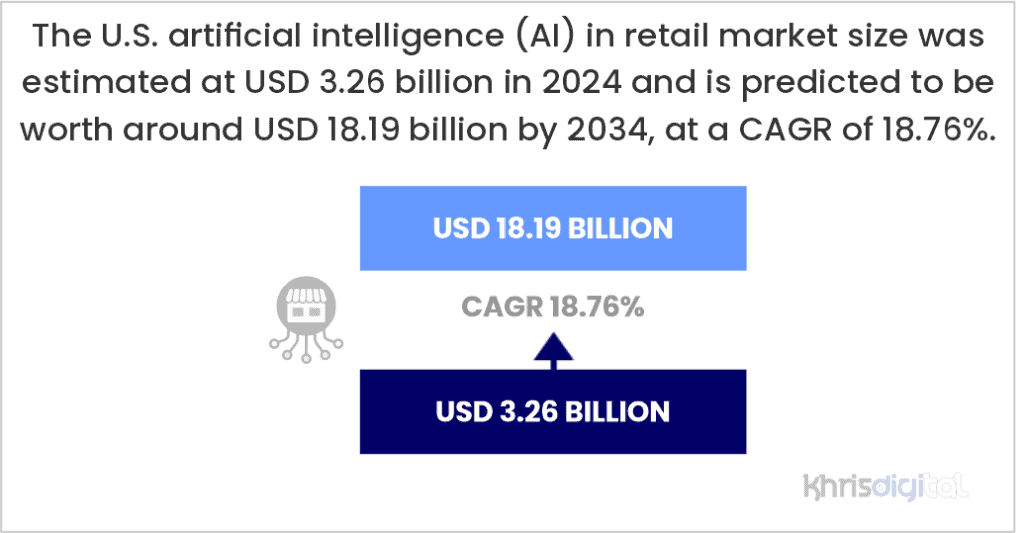
The U.S. retail sector is scaling AI faster than most markets, driven by fierce competition and high customer expectations. Retailers are under pressure to cut costs, personalize experiences, and respond quickly to shifting trends, and AI is answering that call.
From warehouse automation to AI chatbots handling customer service at scale, U.S. brands are embedding smart systems deep into their operations.
10. AI is expected to improve retail efficiencies by +59% by 2035.
(Knight Frank)
This level of efficiency gain shows just how deeply AI is set to impact retail operations. From optimizing supply chains to automating repetitive tasks, AI helps retailers reduce waste, speed up decision-making, and free up human teams to focus on higher-value work.
Retailers are using AI to forecast demand more precisely, restock faster, and personalize experiences without manual effort.
11. Generative AI in e-commerce has been forecasted to reach $2.1 billion by 2032.
(Capgemini)
Generative AI is unlocking new ways for e-commerce brands to attract, convert, and retain customers. From auto-generating product descriptions to creating personalized images, videos, and even entire ad campaigns, it’s changing how content gets made, and how fast.
What once took days now happens in seconds. The projected market growth shows how quickly businesses are adopting these tools to stand out in crowded digital spaces.
12. 80% of retail executives will adopt AI within the next three years.
(Content at Scale)
Leaders are recognizing that staying competitive means automating smarter, reacting faster, and delivering more value to customers with less friction.
AI is being added to roadmaps across departments, from operations and marketing to merchandising and customer service.
13. 78% of surveyed retail executives plan to invest from $500,000 to $5 million.
(Chain Storeage)
These mid- to high-level investments allow companies to go beyond pilot programs and move to full-scale implementation. The focus is shifting from “if” AI should be used to “where” it can deliver the most impact.
Whether it’s smarter demand planning, automated customer service, or predictive analytics, executives are putting real money behind transformation.
14. 49% of retail respondents believe AI offers “substantial” benefits, 51% said AI benefits include innovation, 49% said reduced risk, 45% said increased sales, and 43% said AI helps with marketing campaign personalization.
(Chain Storeage)
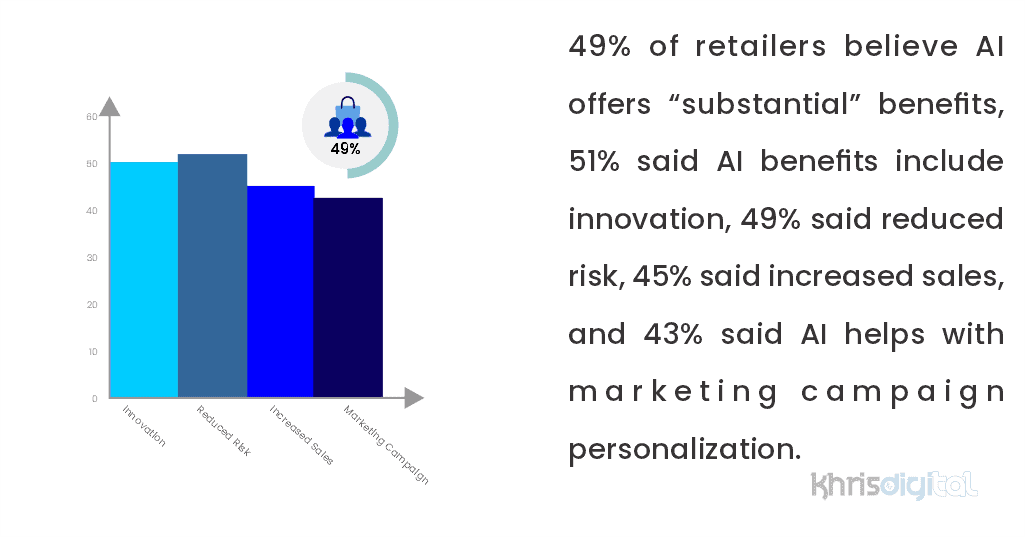
Innovation tops the list, signaling that AI isn’t just improving what exists but creating entirely new ways to operate. Risk reduction is another key win, with AI helping forecast demand more accurately and flag potential issues early.
Increased sales point to AI’s growing role in driving conversions through smarter targeting and faster response times.
15. Only 39% of marketers are using AI to create new experiences for customers.
(SAP Emarsys)
This low adoption rate highlights a significant gap between AI’s potential and its actual use in marketing.
While many brands are leveraging AI for efficiency, fewer are tapping into its creative power to craft entirely new experiences. That means missed opportunities, from interactive product discovery to personalized storytelling that adapts in real time.
16. 72% of retailers already using AI say they experienced a decrease in operating costs.
(SAP Emarsys)

Cost reduction is one of the clearest and fastest wins for retailers adopting AI. By automating repetitive tasks, optimizing inventory, and reducing human error, AI helps businesses operate leaner without sacrificing performance.
These savings can show up in unexpected places, including fewer returns, faster fulfillment, smarter staffing, and even lower energy use.
17. Through improving digital customer interactions, artificial intelligence could bring in an extra $310 billion for the retail sector.
(Neontri)
This projected revenue boost shows the massive upside of getting customer interactions right with AI. From faster response times to hyper-personalized shopping journeys, AI makes digital experiences smoother, smarter, and more satisfying.
When customers feel seen and understood, they spend more and come back more often. AI is helping retailers remove friction at every step, whether it’s chatbots solving issues instantly or smart recommendations increasing average order value.
18. 79% of retail marketers use AI to personalize content and campaigns.
(SAP Emarsys)
Personalization has moved from a nice-to-have to a must-have, and AI is the engine making it possible at scale.
This kind of precision wasn’t possible with traditional tools. AI analyzes browsing behavior, purchase history, and even engagement patterns to deliver content that feels handpicked without manual work.
19. 43% of retailers are piloting autonomous AI, and another 53% are evaluating its uses.
(SAP Emarsys)
Retailers are moving quickly toward a future in which AI can operate with less human oversight. Piloting autonomous AI means testing systems that can make decisions, adapt to changing inputs, and learn from their own outcomes.
These pilots often start with narrow tasks, such as managing stock levels or rerouting deliveries, but the long-term goal is broader automation that runs entire workflows.
20. 70% of retail marketers use AI to optimize campaign performance in real time.
(SAP Emarsys)
Real-time optimization is where AI proves its value on the fly. Instead of waiting for post-campaign analysis, marketers can now adjust creative, targeting, and spend while a campaign is live.
This agility helps teams maximize return on every dollar spent. In fast-moving markets, real-time response isn’t a luxury. It’s a major competitive edge.
21. 58% of retail marketers report increased customer loyalty through AI.
(SAP Emarsys)
AI helps marketers deliver exactly that by learning customer preferences and responding with relevant offers, reminders, and messages. The result is a stronger emotional connection and more repeat visits.
When customers feel understood, they’re more likely to stick around. AI also helps brands recognize loyalty signals early, like shifting behaviors or disengagement, and respond before customers drift away.
22. 60% of retail marketers report increased customer engagement through AI.
(SAP Emarsys)
With real-time personalization, smarter targeting, and dynamic content, brands are cutting through the noise and capturing attention faster. AI tools adjust messaging based on individual behavior, making each interaction feel relevant and timely.
That keeps customers clicking, exploring, and responding. More engagement means more data, which means even better campaigns next time. It’s a cycle of improvement that builds real momentum.
23. 66% of retail marketers use AI to predict future consumer behavior.
(SAP Emarsys)
AI enables marketers to spot patterns, trends, and shifts before they’re obvious. Whether it’s anticipating when someone might reorder or predicting which products they’ll click on next, AI takes the guesswork out of planning.
This level of foresight helps retailers stay ahead of demand, reduce churn, and personalize offers more effectively.
24. 71% say AI helps them launch marketing campaigns faster, saving an average of 2.3 hours per campaign.
(SAP Emarsys)
Speed matters in marketing, especially when trends shift daily, and customer attention spans shrink. AI is helping marketers reduce repetitive setup tasks, generate content faster, and automate testing that used to take hours.
Saving over two hours per campaign gives teams more time to focus on strategy, creative direction, and performance analysis.
25. 72% say AI frees their team to focus on more creative work by reducing repetitive tasks.
(SAP Emarsys)
Repetitive tasks eat up time and energy that creative teams could spend on work that actually moves the needle. AI is shifting that balance. By handling tasks like audience segmentation, A/B testing, and content scheduling, it gives marketers more room to think, experiment, and build new ideas.
26. 88% of retail respondents believe Gen AI will have a medium to high impact on their retail businesses.
(EY)
Generative is now viewed as a real force for transformation. Retailers expect it to impact everything from how content is created to how customers interact with brands online.
This belief reflects growing confidence in Gen AI’s ability to drive speed, scale, and personalization across multiple touchpoints. Retail teams are already testing its use in product descriptions, chatbot conversations, and automated visuals.
27. 50% of retailers already claim to use AI “in some form.”
(Knight Frank)
“In some form” covers a wide range, but it signals that retailers are moving from theory to action.
Even small steps, like AI-assisted email subject lines or dynamic pricing, can make a noticeable impact. Adoption at this level also creates pressure for the rest of the market to catch up.
28. 28% of retailers consider AI a top investment priority.
(Knight Frank)
The retailers making it a top priority are betting on smarter automation, deeper insights, and better customer experiences. They’re not just looking for small wins. They’re aiming to reshape how their businesses operate.
As more success stories emerge, this percentage is expected to rise. For now, these early prioritizers are positioning themselves to lead while others play catch-up.
29. 40% of retailers lack the funds to implement AI strategies.
This funding gap creates a divide between businesses able to move quickly with AI and those left behind. It also highlights the need for scalable, affordable solutions that don’t demand a full tech overhaul.
As AI becomes more accessible through cloud-based platforms and modular tools, this challenge may ease. But for now, limited budgets are keeping many retailers stuck in planning rather than doing.
30. 42% of surveyed retailers already use AI, and 34% are assessing or piloting AI initiatives.
(Nvidia)
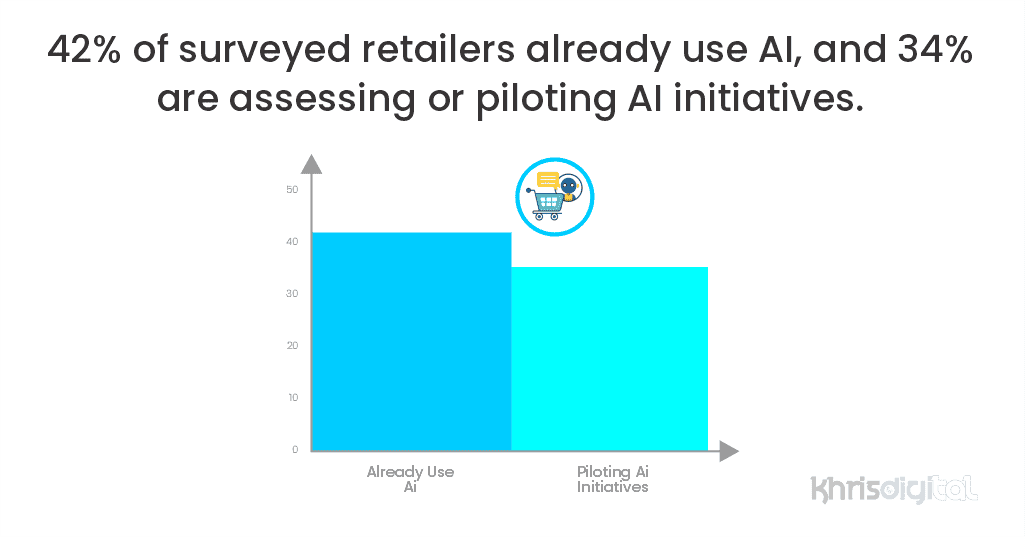
The retailers already using it are likely focused on core areas like personalization, supply chain optimization, or automated support. Meanwhile, those piloting are testing where AI fits best in their operations.
This momentum creates a ripple effect. As more companies find success, others are pushed to act faster to stay competitive. With over 75% either using or testing AI, full-scale adoption across the industry is no longer a question of if, but when.
31. 14% of retailers are unaware of the AI technologies relevant to their business needs.
(Nvidia)
Off-the-shelf solutions don’t always fit every retail model, especially for niche markets or unique workflows.
Some businesses find that current tools are too generic, too complex, or not aligned with their customer journey. As AI continues to mature, retailers need more tailored options that solve specific problems without heavy customization.
32. Larger retailers with annual revenues exceeding $500 million reveal a more pronounced trend: 64% already use AI, 55 percent more than the total retail industry adoption rate.
(Nvidia)
Big retailers are moving faster with AI because they have the resources, teams, and urgency to make it work at scale. These companies are also more likely to have in-house talent or partnerships with AI vendors, giving them an edge in implementation.
The gap between large retailers and the rest of the industry points to a widening divide. While smaller players experiment or hold off, enterprise-level businesses are already deeply embedding AI into their core strategies and gaining ground as a result.
33. 65% of retailers say they understand AI “well” or “very well.”
(Knight Frank)
That shift matters because smarter decisions come from informed leadership. Knowing the strengths and limits of AI helps teams avoid hype and focus on high-impact use cases.
It also builds confidence in rolling out strategies across marketing, logistics, and customer service.
34. 67% of retailers have clear AI investment plans.
(Knight Frank)
Clear investment plans mean there’s internal alignment, defined goals, and a roadmap to move from idea to execution. This signals maturity in the way businesses are approaching AI.
These plans often include budgeting for tools, training, and integration and sometimes restructuring teams to support AI-driven operations.
35. Over 60% of retail respondents plan to increase their AI infrastructure investment in the next 18 months.
(Nvidia)

That includes investing in stronger data systems, cloud platforms, and integrated workflows that can handle real-time AI processes. As use cases expand, retailers need back-end systems that can keep up.
This level of commitment also signals confidence in AI’s value. Instead of one-off projects, companies are preparing to embed AI into daily operations.
36. Over 50% of retail respondents prefer to deploy a hybrid approach for their AI solution.
(Nvidia)
For many retailers, this model makes sense. It supports real-time personalization without sacrificing compliance or internal oversight. Hybrid solutions also help brands manage costs, adapt faster, and scale AI where it’s needed most.
37. 54% of surveyed retailers say they have adopted more than 6 AI use cases in their business. 16% of retailers have only adopted AI in 1 or 2 use cases. The remaining 30% have done so in 3–5 use cases.
(Nvidia)
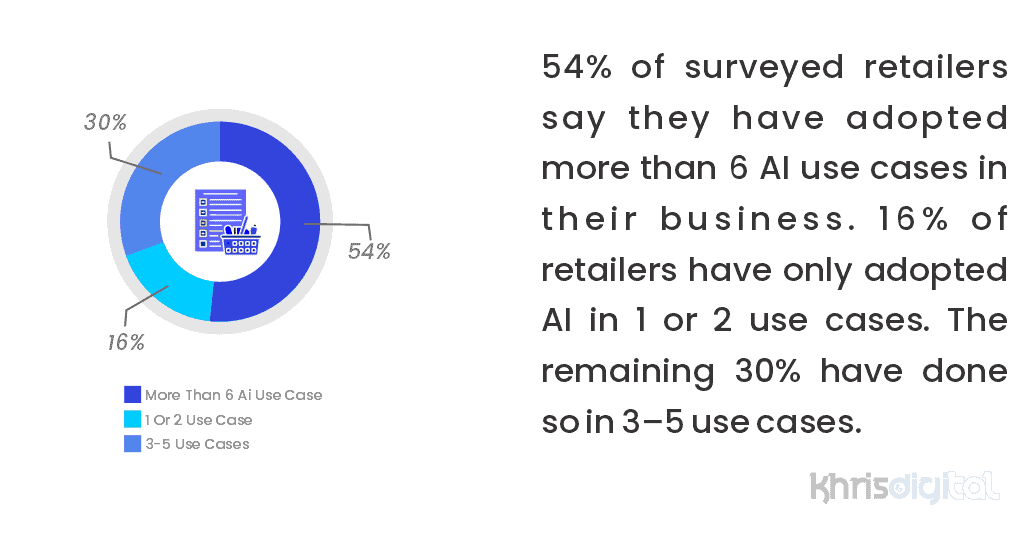
This spread shows how differently retailers are approaching AI, from cautious pilots to full-scale integration. Over half are already applying AI across 6 or more areas, suggesting deep operational commitment.
These use cases likely cover everything from demand forecasting and customer service to pricing, marketing, and fraud detection. Meanwhile, the smaller group just starting out is still testing the waters or working through barriers like cost or complexity.
The middle 30% represents the tipping point, with retailers building momentum and likely to expand fast.
38. Of respondents currently using AI, 69% believe AI has contributed to an increase in their annual revenue.
(Nvidia)
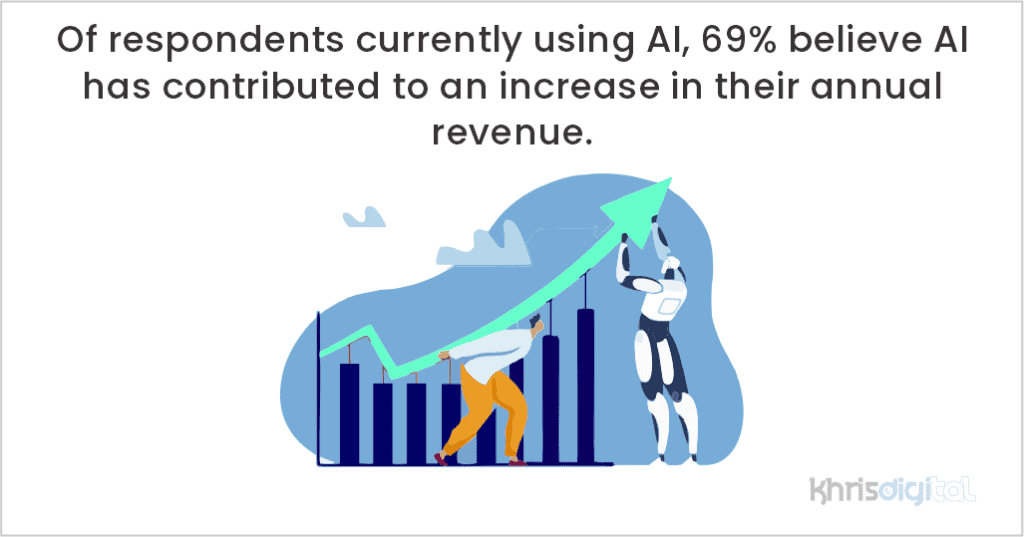
Whether through smarter pricing, better targeting, or more efficient supply chains, AI is helping retailers unlock new revenue streams and increase conversion rates.
These gains often come from doing more with the same resources, powered by automation and faster decision-making.
39. 28% of retailers using AI report an increase between 5 and 15 percent, and an additional 15% of retailers using AI report a rise above 15 percent.
(Cio)
Increases of 5-15 percent are meaningful, especially at scale, and the 15% of retailers reporting even higher growth suggest that when AI is used well, the payoff can be substantial.
These results often come from optimizing pricing, reducing cart abandonment, improving personalization, or increasing upsell success. It’s also a sign that AI is driving front-end performance.
40. C-suite executives reported even more robust results, with 57% stating that AI has driven annual revenue increases and 15% or more in operating cost reductions.
(Cio)
When more than half of C-suite leaders report double-digit revenue gains and cost savings, it confirms that AI is delivering at the highest level. These aren’t surface-level improvements.
They’re strategic wins that reshape profit margins and free up resources. Executives seeing this kind of return are more likely to scale AI deeper into their organizations, expand into new use cases, and build long-term roadmaps around it.
41. Personalized recommendations drive 35% of purchases on Amazon.
(VWO)
Over a third of purchases come directly from these AI-powered suggestions. The system isn’t just recommending random items.
It’s anticipating what customers might want next and offering it at exactly the right moment. This approach keeps customers engaged, increases cart size, and boosts repeat purchases.
42. 75% of retail decision-makers believe that generative AI is an important way for retailers to reinvent themselves.
(PR Newswire)
From creating on-brand content in seconds to building virtual shopping assistants and immersive experiences, generative tools are giving retailers entirely new ways to connect with customers.
Whether through faster creative production or entirely new service models, generative AI is seen as a path to staying relevant, fresh, and competitive in an industry that never stops moving.
43. 59% of surveyed retail executives want to use generative AI to streamline customer service with less human intervention.
(PR Newswire)
Customer service is one of the most resource-heavy parts of retail, and generative AI is making it smarter and faster.
Executives are eyeing it as a way to handle common questions, process requests, and even manage complex interactions with fewer human touchpoints. With generative AI, responses can feel more natural, personalized, and helpful than traditional chatbots.
44. 49% of respondents want generative AI to speed up product categorization and create compelling customer-centric marketing copy.
(Jasper)
Product categorization is tedious but critical, and getting it wrong can mean missed sales and poor search results. AI can handle it in seconds, tagging items with precision based on images, descriptions, and patterns across platforms.
On the creative side, marketers are using generative AI to write headlines, descriptions, and promos tailored to different audiences without starting from scratch.
For nearly half the industry, these two applications represent a clear way to save time, reduce manual effort, and keep messaging sharp and relevant.
45. 44% want to use generative AI to empower retail creative teams to curate unique images and innovative content for campaigns.
Creative teams are under constant pressure to deliver fresh, eye-catching content. Generative AI is becoming a creative partner, helping them produce visuals, concepts, and assets that are original, brand-aligned, and ready to scale.
Instead of relying solely on stock photos or long production cycles, teams can use AI to test new ideas, generate multiple versions, and refine visuals based on campaign goals.
46. 40% of retail decision-makers want to use generative AI to provide interactive responses to shopper inquiries.
(Jasper)
Generative AI is giving retailers a way to meet those expectations with dynamic, conversational responses that feel more human.
Instead of pre-programmed scripts, AI can tailor replies based on context, tone, and intent, making customer support feel more like a real conversation.
47. 38% want to use generative AI to create internal knowledge articles from existing data sources automatically.
(Jasper)
Generative AI offers a way to turn that scattered data into clear, usable content without the manual lift. Automating internal documentation helps teams stay aligned, speeds up onboarding, and ensures employees have fast access to consistent answers.
Whether it’s generating how-to guides, FAQs, or internal wikis, AI helps keep knowledge fresh and organized.
48. Traffic from generative AI sources results in 10% higher engagement, 32% longer site visits, and 27% lower bounce rates when compared to non-AI sources like traditional search engine results pages.
(Netguru)
That’s a strong signal that AI-suggested content is more relevant and aligned with user intent. These users aren’t just skimming. They’re exploring, clicking, and interacting with the site in meaningful ways.
For retailers, this means a higher conversion rate and a deeper brand connection.
49. 67% of retailers believe autonomous AI will bring mostly opportunities.
(Adobe)
This belief reflects growing trust in AI’s ability to handle complex tasks accurately and efficiently.
Retailers see opportunities to scale operations, reduce delays, and stay responsive without adding more workload to their teams. The focus is shifting from fear of automation to excitement about what it can unlock.
50. 81% of retailers trust AI to act autonomously with sufficient guardrails.
(eMarketer)
Retailers are open to letting AI take the lead on tasks such as pricing, product recommendations, and inventory adjustments as long as guardrails are in place.
The high level of trust suggests retailers are seeing strong results from early automation efforts and are ready to expand. With well-defined limits, AI can act independently without risking mistakes that impact customer experience or revenue.
51. 22% of shoppers use AI for product discovery and inspiration at least occasionally,
(Salesforce)
Whether it’s through chatbots, visual search, or generative tools that suggest styles or bundles, AI is becoming a discovery engine. This behavior shift points to a growing comfort with AI-powered experiences that feel more like conversations than transactions.
52. Only 24% of consumers are comfortable sharing data with an AI shopping tool.
(eMarketer)
Concerns around privacy, transparency, and control are holding back wider acceptance. For retailers, this means earning trust by clearly communicating how data is collected, protected, and used to improve the customer experience.
Until then, even the smartest tools may be limited by hesitation at the source: the shopper.
53. Gen Z shoppers are 10x more likely (20%) than baby boomers (2%) to frequently use AI to discover new products.
(Biz Community)
Gen Z is growing up with AI as part of everyday life, from personalized playlists to smart assistants, so using it to find new products feels natural. They’re drawn to fast, interactive, and hyper-personalized experiences that traditional search just doesn’t offer.
On the other hand, baby boomers tend to rely more on familiar channels and may not fully trust or understand AI-driven tools.
54. Gen Z shoppers are 2.7 times more likely than baby boomers to be interested in receiving product recommendations from AI.
(Biz Community)
This generation is used to curated experiences, whether it’s in their news feed, streaming queue, or shopping cart. AI-powered recommendations feel like a natural extension of how they already interact with digital platforms.
Baby boomers, by contrast, tend to prefer more control and transparency in their shopping journey.
55. Over half of Gen Z and 39 percent of the general population already use AI for product discovery.
(Biz Community)
More than half of Gen Z is already turning to AI to surface new products, whether through smart search tools, visual discovery, or conversational assistants.
The broader population is catching up fast, with nearly 4 in 10 using AI in some form to explore options. This shift reflects a growing demand for shopping experiences that feel curated and efficient rather than random or time-consuming.
56. 20% of shoppers have used AI for customer service, and 18% for purchases at least occasionally.
One in five shoppers is already interacting with AI-powered support, from chatbots answering questions to virtual assistants resolving issues.
Nearly as many have used AI to help complete a purchase, whether through guided selling tools, smart recommendations, or conversational checkouts. These touchpoints show that AI is becoming a trusted part of the decision-making process.
57. 70% of shoppers are at least somewhat interested in AI agents helping them optimize their loyalty points.
(eMarketer)
Loyalty programs often leave value on the table simply because customers don’t know how or when to use their points.
AI changes that. Shoppers are open to having smart agents track their balances, suggest redemptions, and alert them to expiring rewards without manual effort.
58. 87% of shoppers who have tried GenAI tools are excited about the positive impact the technology has on their shopping journeys.
(Neontri)
When shoppers actually experience what generative AI can do, the response is overwhelmingly positive. From faster product discovery to more personalized support, these tools are making the process feel smoother and more intuitive.
Shoppers are noticing the difference, whether it’s getting relevant suggestions without searching or receiving helpful answers in real time.
59. 73% of consumers are open to AI-powered chatbots for customer service.
(Apollo Technical)
The majority of consumers are no longer resistant to talking with bots as long as the experience is smooth, fast, and helpful. AI-powered chatbots have come a long way from clunky scripts and dead ends.
Today’s versions can understand intent, respond in natural language, and resolve common issues without needing to escalate. That’s exactly what shoppers want: instant answers without waiting on hold or navigating confusing menus.
60. Chatbots reduce issue resolution time from 38 hours to 5.4 minutes in customer service.
(Crazy Egg)
Cutting resolution time from nearly two days to just minutes is a complete overhaul. Fast support builds trust, reduces frustration, and boosts satisfaction.
Chatbots can instantly access order info, track deliveries, or guide customers through returns without waiting in a queue. For retailers, it means fewer backlogs, happier customers, and a leaner support operation that moves at the pace shoppers expect.
61. 60% of people have already used virtual assistants to make purchases through voice commands.
(Neontri)
Whether through smart speakers, phones, or in-app assistants, shoppers are using voice to reorder items, check prices, and make hands-free purchases. It saves time, skips typing, and fits into busy lifestyles.
62. Only 17% of consumers think AI is having a negative impact on their retail experiences.
(SAP Emarsys)
The small share of dissatisfaction likely comes from clunky experiences or a lack of transparency. For retailers, this is a green light to keep building with confidence, as long as the focus stays on relevance, control, and ease.
63. 33% of US shoppers report a positive impact of AI on their retail experience.
(SAP Emarsys)
These improvements often come in the form of faster service, better recommendations, and smoother navigation across platforms. While not every shopper may realize AI is behind the scenes, they notice less friction, more relevance, and quicker answers.
64. 69% of consumers are satisfied with AI-powered product recommendations.
(SAP Emarsys)
That’s a strong vote of confidence in systems designed to predict what shoppers actually want. When done well, these suggestions feel less like marketing and more like a helpful nudge, leading to faster decisions and more relevant purchases.
The satisfaction rate also shows how far the tech has come, from hit-or-miss suggestions to personalized, real-time results based on behavior, interests, and past activity.
65. 55% of consumers say AI makes shopping easier, and 53% say it makes it faster.
(SAP Emarsys)
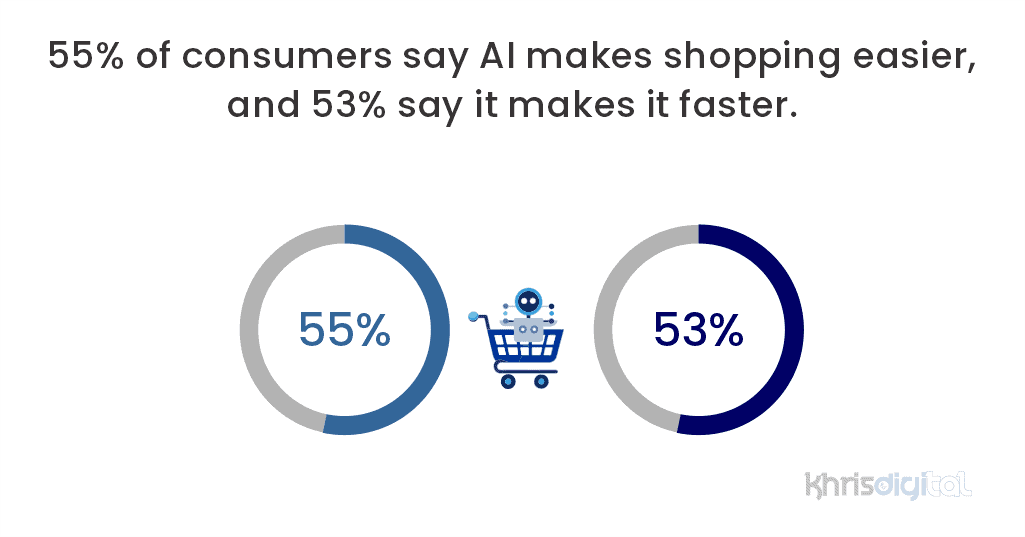
Convenience is everything in modern retail, and AI is clearly delivering on that front. More than half of consumers say it simplifies the process, whether by narrowing choices, surfacing the right products, or automating tasks.
Speed matters too, and AI’s ability to reduce decision time, automate support, and personalize search results is shaving minutes off every interaction.
66. 75% of retail customers are more likely to buy again from brands that personalize their shopping experience.
(Neontri)
When shoppers feel like a brand understands their preferences, habits, and needs, they’re far more likely to come back. That could mean tailored product recommendations, personalized email offers, or a shopping journey that remembers where they left off.
67. Brands leveraging advanced digital personalization tools see revenue jump by 6% to 10%.
(McKinsey)

When retailers tailor the shopping experience with advanced AI-powered tools, customers respond with more clicks, larger carts, and stronger loyalty. These revenue gains come from smarter targeting, better timing, and higher engagement throughout the buyer journey.
68. 25% of consumers say retailers should use AI to make shopping more personal, but only 29% feel they receive enough value in return for their data.
(SAP Emarsys)
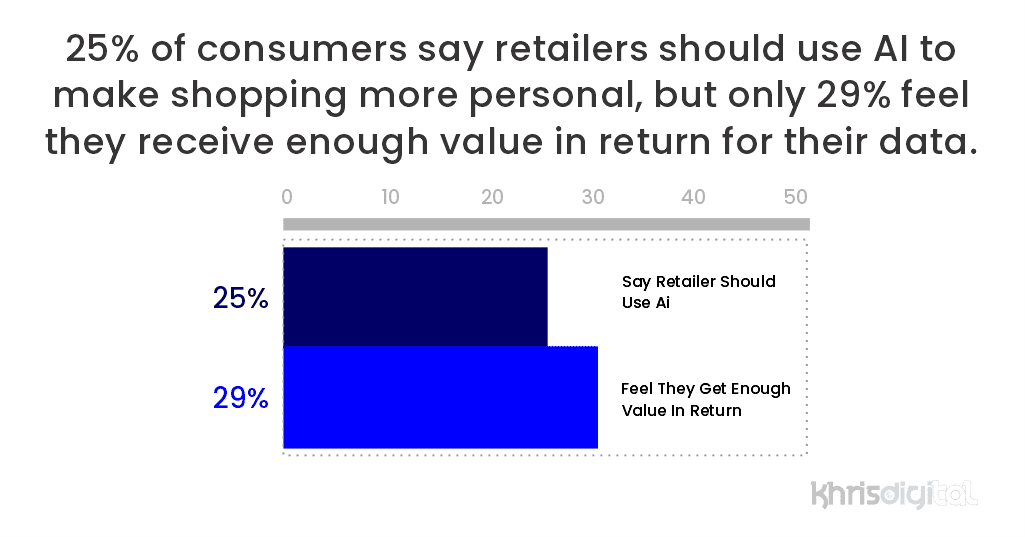
There’s a gap between what consumers want and what they’re getting. While many are open to AI-driven personalization, they’re not convinced the trade-off is worth it.
Shoppers are handing over their data, such as purchase history, preferences, and behaviors, but only a small portion feel the value they get in return matches that exchange. This signals a need for retailers to be more transparent, relevant, and consistent with how they use data.
69. 64% of consumers prefer interacting with a chatbot rather than waiting for a human agent.
Fast, accurate, and available 24/7, chatbots are becoming the go-to choice for everyday support. This preference shows that convenience is winning, especially when the bot can resolve issues quickly without bouncing users around.
70. 52% of consumers who spoke with an AI agent on the phone reported a positive experience
(SAP Emarsys)
AI voice agents are starting to prove themselves in one of the most challenging areas: phone support. Over half of consumers who’ve interacted with one walked away satisfied.
This is a solid sign that these tools are getting better at sounding natural, understanding intent, and solving real problems.
71. 55% of consumers use voice search to search for products.
Voice search is quickly becoming part of the everyday shopping routine. Whether it’s asking a smart speaker for deals or using a phone to find a specific product hands-free, over half of consumers are now using their voice to browse.
For retailers, it means optimizing for voice is no longer optional. Product titles, descriptions, and site structure need to be voice-friendly, clear, and natural.
72. 44% of consumers have already used voice search to add items to their shopping lists.
(Neontri)
Voice-enabled shopping is making everyday tasks easier, and adding items to a list is one of the clearest use cases. It’s faster than typing and helps people stay organized without breaking their routine.
73. In the USA, 33.2 million consumers have harnessed voice search to make purchases.
(Netguru)
These transactions range from everyday essentials to reordering favorites, showing how voice fits naturally into regular shopping habits. The key driver is convenience with no screens, no typing, just fast, frictionless buying.
74. 42% of US shoppers would support brands bringing more AI into the buying experience.
(SAP Emarsys)
Shoppers are open to smarter, more personalized experiences if it means less hassle, better suggestions, and faster service. This support gives retailers the green light to push further with AI-driven tools like smart assistants, dynamic pricing, and predictive personalization.
75. 47% of US retail marketers report increased customer loyalty through AI.
(SAP Emarsys)
That’s happening through smarter engagement, personalized experiences, and faster support powered by AI.
When customers feel seen and valued, they stick around. And with AI doing the heavy lifting behind the scenes, brands can scale that personal touch across millions of interactions.
76. 55% of US marketers believe they offer consumers enough value in exchange for their data.
(SAP Emarsys)
More than half of U.S. marketers feel confident that their use of customer data delivers real value, whether through personalization, exclusive offers, or smoother shopping experiences. But this belief doesn’t always match consumer perception.
The challenge lies in making the value obvious. If shoppers can’t clearly see how their data is improving their experience, trust can erode.
77. Almost 60% of businesses rely on fully automated AI-powered marketing campaigns to deliver customer content.
(Retail Economics)
Automation has taken center stage in marketing, and AI is the engine behind it. These systems can adapt in real time, adjusting offers, messages, and creatives based on user behavior.
78. 54% of retail marketers use AI-driven personalization across channels to drive business growth.
(Retail Economics)
AI connects the dots between customer actions and preferences, wherever they occur, and delivers content or offers that make sense in the moment. This cross-channel approach keeps messaging aligned, increases engagement, and helps push customers further down the funnel.
79. Over 53% of retailers stated that they would prioritize AI investment in their warehousing and distribution divisions.
(Retail Economics)
From real-time inventory tracking to predictive restocking and robotic picking systems, AI is helping streamline the entire supply chain. These tools reduce errors, shorten delays, and improve fulfillment speed while lowering operational costs.
80. 46.9% of retailers said they wanted to improve their buying and merchandising with AI.
(Retail Economics)
Buying and merchandising decisions shape what customers see and whether those products actually sell.
AI helps identify trends early, predict demand with greater accuracy, and optimize assortments using real-time data rather than outdated instincts. It can also reduce overstock, minimize markdowns, and improve margins by better aligning supply with customer behavior.
81. Nearly 85% said they thought that AI-powered data analytics would enable more sophisticated targeting of customers.
(Retail Economics)
Targeting is only as good as the insights behind it, and AI is giving retailers a serious upgrade. These tools can process massive amounts of customer data to uncover patterns that humans would miss, from timing preferences to cross-channel behavior.
That means brands can reach the right people with the right message at the exact right time.
82. Over 50% of retailers and consumer brands believe AI-powered inventory management systems will improve demand planning, replenishment, and stock rotation.
(Retail Economics)
AI-powered systems can track real-time demand signals, forecast future trends, and adjust stock levels automatically across locations. This means better replenishment, less overstock, and smarter rotation of seasonal or perishable goods.
83. According to a survey of retail and consumer brands, 36% believe autonomous vehicles will significantly impact the industry.
(Retail Economics)
From driverless delivery vans to robotic last-mile solutions, this tech could unlock new levels of speed and efficiency, especially in urban and high-demand areas. The belief in their impact reflects growing interest in automation beyond store walls.
As regulations catch up and pilot programs expand, autonomous vehicles could become a serious differentiator in retail logistics.
84. 53% of US marketers believe AI is essential for fully leveraging their customer data to achieve business goals.
(SAP Emarsys)
AI helps unlock patterns, predict behaviors, and personalize experiences in ways traditional tools can’t match. It transforms disconnected data points into clear actions, whether that’s improving segmentation, optimizing campaigns, or driving smarter product recommendations.
85. One-third of UK consumers believe customer service has deteriorated, and 50% cite chatbots as a source of frustration.
(Knight Frank)
The problem usually isn’t the idea of automation, but the experience it creates. When bots are rigid, unhelpful, or cannot properly escalate issues, frustration builds quickly. This stat is a clear reminder that convenience shouldn’t come at the cost of quality.
86. 71% of retail companies in India intend to implement AI within the next year.
(EY)
India’s retail sector is gearing up for a major leap in AI. The drive comes from a mix of rising consumer expectations, fierce competition, and a growing digital economy. From supply chain optimization to multilingual customer support, AI offers scalable solutions tailored to India’s diverse and fast-moving market.
Final Thoughts on AI in Retail Statistics
AI in retail is no longer experimental. From the front-end experience to the back office, AI is powering faster decisions, sharper targeting, and better customer service.
The stats show that retailers using AI are seeing higher revenue, lower costs, and stronger customer loyalty. But the data also shows that execution matters. Trust, transparency, and meaningful personalization are what separate useful AI from forgettable tech.
The next wave of winners won’t be the ones with the most data, but the ones who know how to use it well. Whether you’re a retailer exploring your first AI tool or scaling across multiple touchpoints, the opportunity is massive and growing fast.
Sources:
Check out my other Statistics round up:
