

How do your conversion rates really stack up?
If you’re like most people staring at your analytics dashboard, with a nagging thought: This should be doing better.
And you’re not alone.
Only 22% of businesses say they’re actually satisfied with their current conversion rates. That means nearly 4 out of 5 feel like they’re leaving money on the table.
The good news? You don’t have to stay in that frustrated majority.
This post breaks down the most eye-opening conversion rate optimization statistics and what they actually mean for your business.
Every statistic here is verified and backed by reputable industry sources (linked at the bottom, so you know it’s not guesswork).
Let’s see where the real growth opportunities are hiding.
🔑 Key Conversion Rate Optimization Statistics:
1. On average, websites convert about 2.35% of their visitors into customers.
(Invesp)
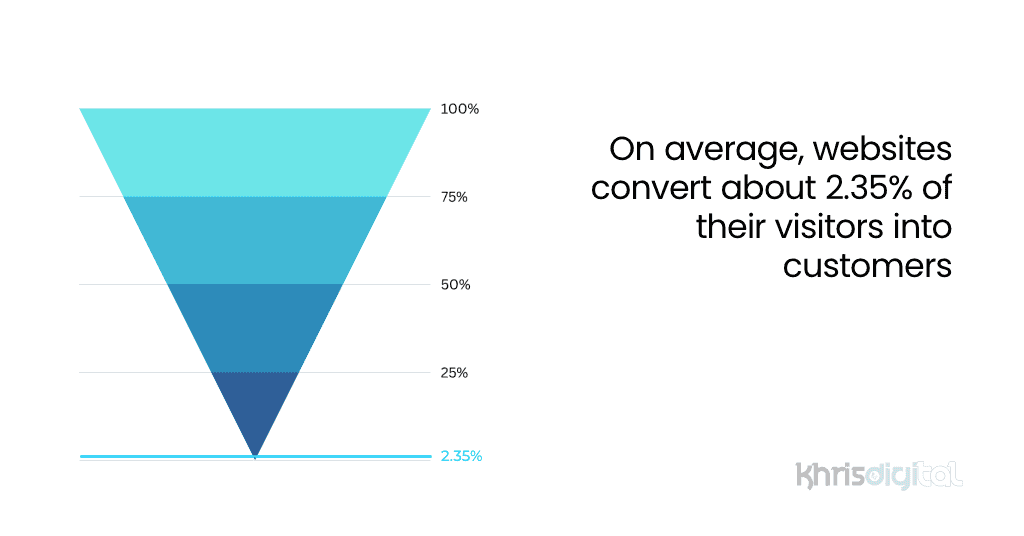
That means that out of 100 people who land on your site, only about two end up buying. If you’re not testing, refining, and optimizing your site, you’re losing 97% of your traffic.
The thing is, 2.35% is just the average. Top-performing sites? They’re pulling in 3 to 5 times more conversions by obsessing over the little things like headlines, page speed, CTAs, trust signals, all of it.
If you’re anywhere near that 2.35%, you’re sitting on untapped potential. And that’s precisely why conversion rate optimization matters.
2. The average conversion rate for mobiles is 1.53%, compared to 4.14% on desktops.
(Plerdy)
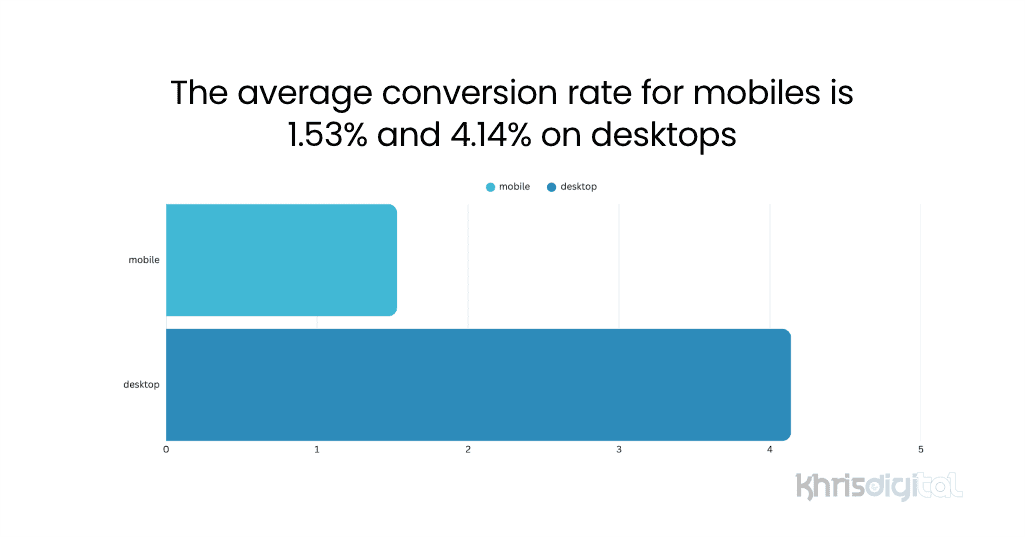
Mobile traffic converts at less than half the rate of desktop. And yet, most of your visitors are probably coming from their phones.
That gap? It’s killing your potential sales.
People browse on mobile but buy on desktop, usually because mobile experiences are clunky, slow, or frustrating. Tiny buttons, endless forms, pop-ups that won’t close. It all adds friction, and friction kills conversions.
So if your mobile site is just a shrunken version of your desktop site, you’re leaving a lot on the table. Want to close that gap? Start treating mobile as its own customer journey, not an afterthought.
3. For every $92 brands spend acquiring customers, only $1 is spent converting them.
(HubSpot)
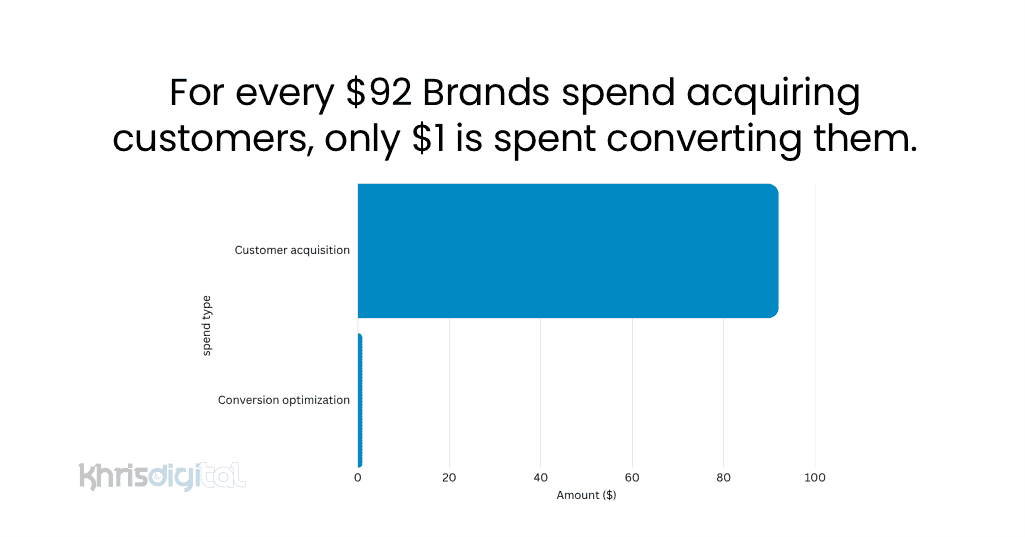
Imagine pouring buckets of money into ads, social, and SEO to bring people in. And then barely spending anything to get them to buy. That’s what most businesses are doing, blowing their budget on traffic while their site fumbles the sale.
It’s like throwing a party, inviting a hundred people, and forgetting to serve food.
Customer acquisition is expensive, and conversion is where the real profit margin lives.
If you shift even a fraction of your ad budget into better copy, smarter UX, or optimized funnels, you’ll start seeing more wins without needing more traffic.
4. Only 22% of businesses are happy with their current conversion rates.
(SalesLion)
Almost 80% of businesses are walking around knowing their website could, and should, be doing better. And yet, most of them aren’t sure where to start, so they settle.
Low satisfaction usually isn’t about the product or the offer. It’s about the experience, the speed, clarity, trust, and usability of your site. Fixing that doesn’t require a complete overhaul.
Often, it’s minor tweaks: clearer calls to action, better social proof, simpler forms.
5. The average conversion rate for e-commerce sites across various sectors is just over 1.5%.
(Keywords Everywhere)
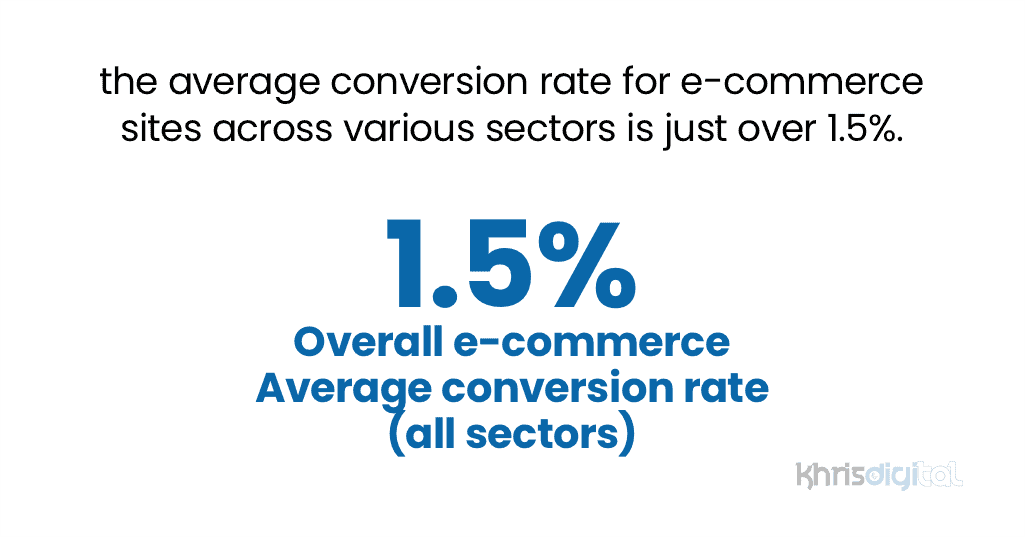
That’s not great, especially when you’re spending time, money, and energy to get people to visit your store.
A 1.5% conversion rate means 98 out of every 100 visitors don’t buy. Not because your product sucks, but because something along the journey isn’t clicking.
Maybe it’s price, perhaps it’s trust, maybe it’s that awkward checkout flow.
Many brands don’t even realize how low their conversion rate actually is, or that it could be significantly higher. The top 10% of ecom stores? They’re converting at 3x or even 5x that rate.
So if you’re hovering around that 1.5%, don’t panic. But don’t ignore it either. That number is your growth lever.
6. Businesses spend $2,000 per month on CRO tools.
(DemandSage)
That’s not small change, and it tells you that companies are taking conversion seriously. Or at least, they want to.
But buying tools doesn’t guarantee results. If you’re dropping $2K monthly on software but not using it to run smart tests, track real behavior, or fix what’s broken, you’re just burning cash.
The tools are there to amplify your efforts, not replace them. So before you invest, ask: do you have a clear strategy? Are you fixing known problems or just guessing? Without a plan, $2K is just noise.
7. The top Google result gets a 27.6% click-through rate, which is 10x more than the #10 spot.
(Keywords Everywhere)
Ranking first is where the traffic actually goes.
Think about how you search. You probably click the first link that looks decent and ignore the rest. Your customers do the same. That #1 spot grabs over a quarter of all clicks, while the #10 link barely gets noticed.
So even if your SEO is “good enough” to land you on page one, if you’re not near the top, you’re invisible. CTR is about trust, relevance, and that first impression.
8. Google Ads campaigns average a 4.8% conversion rate.
(Invesp)

That 4.8% may not sound huge, but in the CRO world, it’s pretty strong. Especially compared to the 1.5% average on e-commerce sites.
Why? Because search intent is high. When someone Googles a specific product or service, they’re already halfway down the funnel. You’re not interrupting, you’re answering.
To hit or beat that 4.8%, your landing page has to match the ad. Relevance is everything. If your ad promises one thing and the page delivers another, your conversions tank fast.
9. Conversions can drop by up to 20% for every one-second delay on mobile.
(Think with Google)
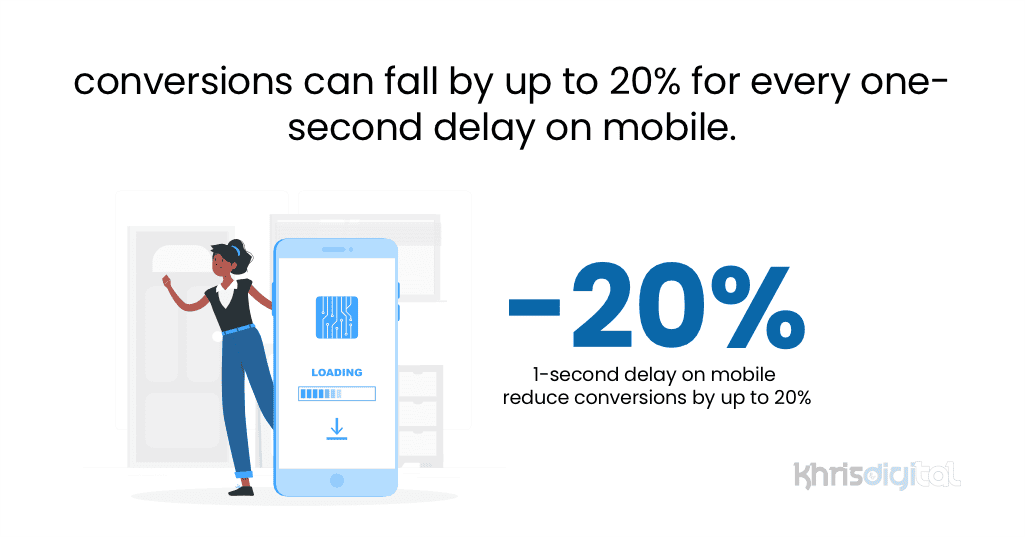
One second. That’s all it takes to start bleeding sales.
Mobile users don’t wait, they bounce. If your page lags, stalls, or takes too long to load, they’re gone before your headline even shows. And each extra second? It’s slicing away up to 20% of your conversions.
So before you chase new traffic or fancy design updates, fix your load time. Compress images, cut clutter, and make mobile speed a priority.
10. Making your website just one second faster can boost conversions by 7%.
(WebFX)
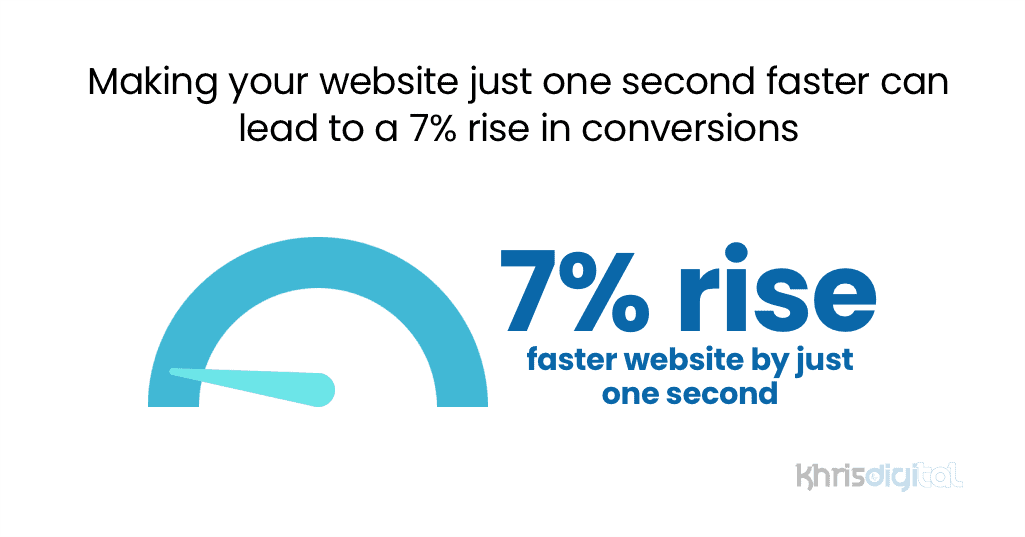
This is the flip side of the speed equation. We know slow kills, but fast pays. When your site loads quickly, visitors stick around, trust builds faster, and buying feels easier.
And the best part? It’s one of the simplest CRO wins out there. No redesign. No new copy. Just better performance.
Think of speed as silent persuasion, nobody sees it, but everyone feels it. And the impact? Real, measurable, and immediate.
11. Keeping your site load time under 2 seconds can increase conversions by 15%.
(WebFX)
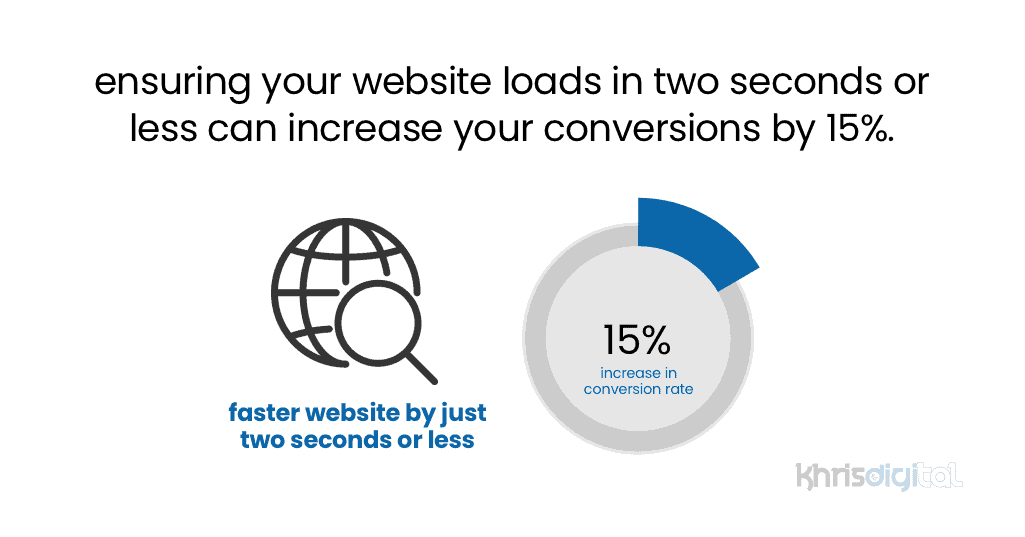
Two seconds. That’s the magic number.
After that, every extra moment you make someone wait chips away at their patience, and your revenue. But hit that sub-2-second sweet spot? You’re looking at a potential 15% boost in conversions.