

Is AI making us more productive or just making us busier? That’s the big question everyone’s asking right now. AI tools are popping up everywhere, promising to save time, boost output, and revolutionize workflows.
But what do the numbers say?
This post breaks it all down. I’ve gathered the most eye-opening, revealing AI productivity statistics to show you exactly how AI is impacting work across teams, industries, and daily routines.
From time-saving to shifts in hiring to new ways people work smarter, the numbers speak loud and clear.
These statistics are from reputable and verified sources, and you will find a list of the sources at the bottom of the article.
Let’s get into it.
1. The AI market is set to grow to $1.3 trillion by 2032.
(Forbes)

AI quickly becomes a core business driver, touching everything from customer service and sales to supply chain and HR.
Why does this matter for AI productivity? Money flows where value is created. This massive growth shows that companies are investing heavily in AI because it saves time, cuts costs, and helps people get more done with less.
Whether automating data entry or enhancing decision-making, AI is showing real ROI. And when an entire industry is set to explode like this, you can bet its tools will become everyday essentials in the workplace.
2. The global AI market size is expected to reach an annual growth rate of 28.46% between 2024 and 2030.
(Statista)
Year over year, more businesses are adopting AI tools as essential parts of their operations, not just add-ons. For productivity, this kind of growth means acceleration on every front. We’re looking at entire workflows being redesigned with AI at the center.
The type of scale this stat points to will bring smarter automation, sharper insights, and new tools we haven’t even imagined yet. And because this is sustained momentum, workers and companies who lean into AI now are setting themselves up for long-term wins.
3. AI is expected to add 21% to the U.S. GDP by 2030.
(Investment NSW)
The reason? AI is unlocking productivity gains across nearly every sector. In healthcare, it’s helping doctors diagnose faster, and in manufacturing, it’s reducing downtime.
In offices, it’s cutting hours of manual work down to minutes. Multiply that by millions of businesses and workers, and you’ve got a serious bump in GDP. When machines handle the grunt work, humans can focus on higher-level tasks.
4. Artificial intelligence adoption can result in a 2.9% annual labor productivity growth in the U.S.
(The Business Dive)

This sustained growth means more output without necessarily adding more hours or people. And AI is right at the heart of that shift.
Productivity gains used to come from better tools or improved processes. Now, AI is leapfrogging both. Whether automating reporting, writing content, analyzing data, or handling customer questions, AI is lifting the load in a way that stacks up over time.
5. Generative AI tools could lead to a 0.1% to 0.6% yearly increase in labor productivity through 2040.
(McKinsey)

At first glance, a 0.1% to 0.6% annual productivity boost might seem modest. But that steady growth compounds a significant shift in our work over time.
According to McKinsey, generative AI tools that can create content like text, images, or code has the potential to reshape productivity across industries. This increase hinges on how quickly and effectively organizations adopt the technology and redeploy workers into new roles.
6. Nielsen found a 66% boost in employee productivity with AI tools.
(Nielsen)
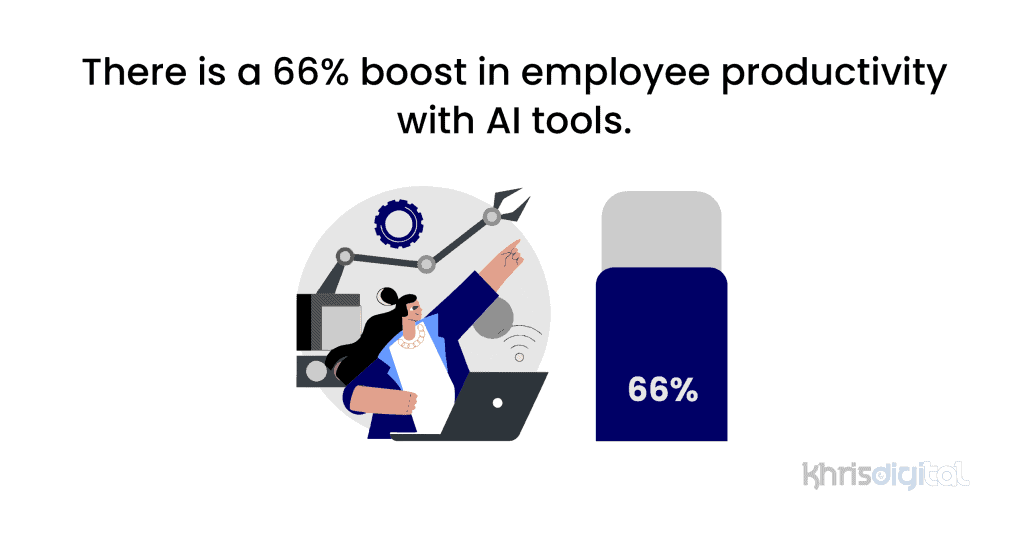
When Nielsen ran tests with AI tools in the workplace, the results were precise: employees could get more done faster and with less effort. That kind of lift can reshape entire departments.
So, what’s behind the big boost? AI handles the busy work. It speeds up research, drafts reports, analyzes data and even helps brainstorm creative ideas. Instead of wasting hours on repetitive tasks, workers can focus on higher-value contributions.
7. 80% of workers using AI say they’re more productive.
(ZD Net)

When workers themselves notice a shift, that’s when you know AI productivity is making a real-world difference. It’s not just about saving time (though that’s a big part). AI helps people feel less overwhelmed.
It assists with writing, summarizes meetings, automates tasks, and even helps with decision-making. That mental lift without having to start from scratch on every task adds up fast.
This also shows a shift in mindset. People aren’t afraid AI will take their jobs, but they see it as a helpful assistant. And that change in attitude fuels adoption and long-term impact.
8. Workers using AI daily feel happier (31%), more connected (32%), and have better work-life balance (26%).
(Forbes)
When AI takes over the repetitive, draining parts of work, people have more energy and time for meaningful tasks and for themselves. Less stress. Fewer late nights. More focus. That’s what balance looks like.
Feeling “more connected” might seem surprising, but it makes sense. AI tools often improve communication, collaboration, and transparency, bringing teams closer. And job satisfaction goes up when the tech works with you, not against you.
9. Companies using AI see up to 40% more productivity in some areas.
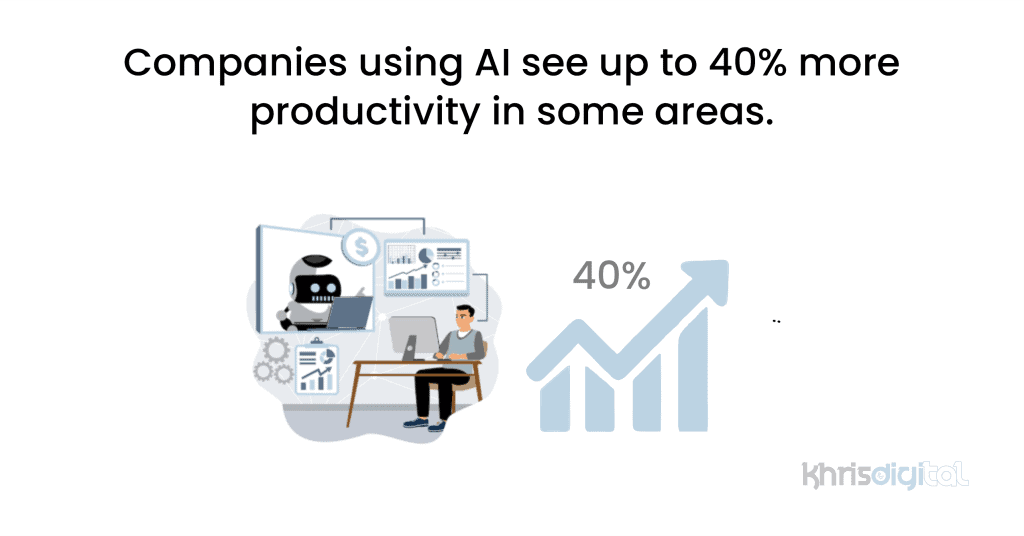
These gains don’t happen everywhere, all at once. However, AI is making a measurable difference in areas like customer support, content creation, data analysis, and internal operations.
Chatbots handle simple queries instantly. AI writers speed up content production. Predictive analytics make decisions smarter and faster.
Companies seeing the most significant boosts are strategically applying it where the bottlenecks are worst. The result? Faster turnaround times, fewer errors, and teams freed up to do more high-impact work.
10. McKinsey says AI could make corporate profits go up by $4.4 trillion each year.
(McKinsey)
This profit spike comes from three main places: automating routine work, improving decision-making, and boosting innovation. When AI helps businesses work faster, smarter, and with fewer mistakes, the savings and growth opportunities multiply fast.
And it’s not just tech giants or startups seeing the upside. Industries like manufacturing, finance, retail, and healthcare all stand to gain, especially when they use AI to streamline supply chains, personalize customer experiences, or optimize operations.
11. Generative AI could disrupt tasks for 30% of workers.
(Brookings)
“Disrupt” doesn’t always mean “replace.” It often means rethinking how tasks are performed. Instead of spending hours writing reports, drafting emails, or analyzing data, AI can handle the first draft, and the human steps in to refine and direct.
This kind of change can feel scary but it’s full of potential. It pushes workers to upskill and focus on creativity, strategy, and collaboration.
12. Generative AI can make skilled workers 40% better at their jobs.
(MIT Sloan)
That’s like upgrading your best employees without hiring anyone new. How? By taking over the tedious stuff and acting as a creative or analytical partner.
AI drafts content for writers, analysts, and marketers. It generates campaign ideas for marketers and crunches data for analysts. Skilled professionals still drive the vision, and AI gets them there faster and with less friction.
13. With the help of AI, support agents now handle 13.8% more questions, and business professionals write 59% more documents per hour.
(Nielsen)
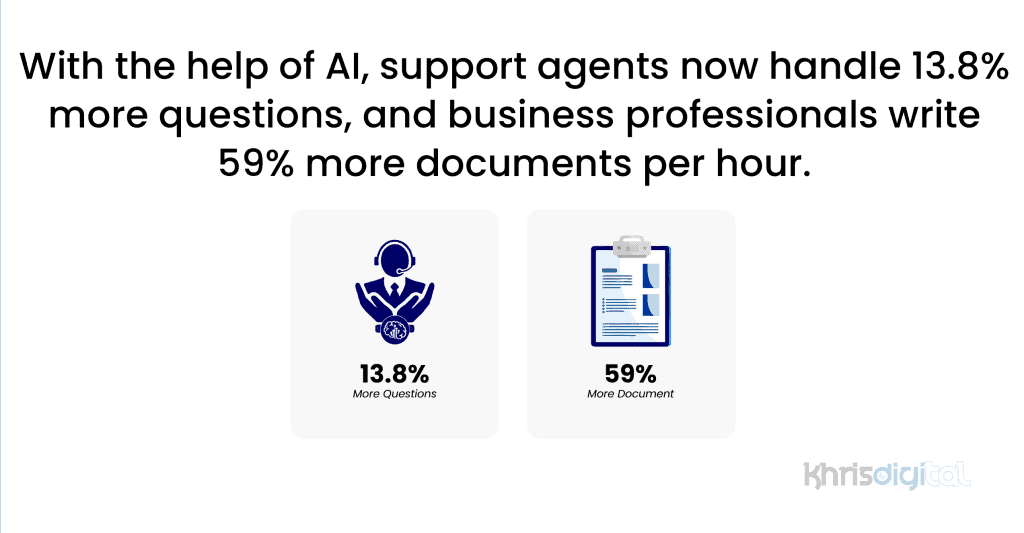
In customer support, AI-powered assistants like chatbots and smart ticketing systems help agents instantly prioritize, draft replies, and even suggest solutions. That means more customers helped in less time without burning out the team.
AI drafts outlines, rewrites text for content creators, and speeds up the research process. What used to take hours now takes minutes, letting writers focus on polishing instead of starting from scratch.
14. Manufacturing and information services lead in AI use (12%), while construction and retail lag behind (4%).
(MIT Sloan)
This gap says a lot about how different industries are approaching AI productivity. AI is a natural fit for manufacturing, particularly in predictive maintenance, supply chain optimization, and quality control.
Information services thrive on automation, data analysis, and content generation, which are AI goldmines. So they’re jumping in early and seeing fast returns.
However, industries like construction and retail, where hands-on work dominates, and digital processes are less mature, are moving more slowly. That hesitation could mean missed opportunities to streamline operations, reduce errors, or improve customer experience.
15. Developers who use AI tools for coding are 88% more productive than those who do not.
(Github)
This stat shows just how much faster and more efficient developers’ work becomes when using AI coding assistants like GitHub Copilot, ChatGPT, or Tabnine.
AI tools help by auto-completing code, suggesting fixes, writing functions, and explaining complex logic in plain language. Instead of spending hours debugging or searching Stack Overflow, devs can move quickly from idea to implementation.
But speed is not the only factor; it also affects mental load. These tools reduce context switching and repetitive typing, letting coders stay in the flow longer. This translates to cleaner code, fewer bugs, and faster project turnarounds.
16. AI could add $7 trillion to the world’s GDP.
(Goldman Sachs)
How does AI generate that kind of value? By automating workflows, speeding up analysis, reducing errors, and enabling better decision-making, everything can be made more efficient.
From small startups to massive enterprises, the time and money saved turn into new revenue, higher profits, and stronger economies.
This stat also points to a widening gap between companies (and countries) that adopt AI early and those that lag. The early adopters are positioning themselves to lead in their industries and economic influence.
17. 64% of companies think AI will make work better.
(Forbes)
That’s a significant shift from the fear-driven headlines about job loss and replacement. More businesses see AI as a tool for better, more human work.
What does “better” mean here? It’s less about doing more work and more about doing meaningful work. AI can handle repetitive tasks such as reports, data entry, and scheduling so people can focus on strategy, creativity, and connection.
18. 75% of companies think AI will help their business.
AI’s value shows up in different ways depending on the company. For some, it automates repetitive tasks and saves time. For others, it analyzes huge data sets and uncovers insights a human would miss. For almost everyone, it makes workflows faster and smoother.
This widespread belief signals a tipping point that AI is no longer just for tech firms or innovators. It’s being embraced by retailers, manufacturers, agencies, and beyond. Companies that wait risk falling behind.
19. More than 60% of business owners think AI will increase productivity.
(Forbes)
From streamlining operations to cutting down repetitive tasks, AI can help teams finish more quickly.
Business owners are seeing how AI can handle the “time-suck” tasks that slow everyone down: emails, data entry, inventory tracking, and scheduling. It’s like giving every employee a sidekick that never sleeps and doesn’t make mistakes.
20. Only 12% of leaders think their teams are ready for AI.
(Swiss Cognitive)
It shows that while the tools advance fast, people and training aren’t keeping pace. It’s not that employees can’t learn; it’s that most haven’t been given the chance. Many teams don’t have the guidance, support, or time to get comfortable with AI tools.
And without that foundation, even the best tech won’t make a dent in productivity. For companies to reap the benefits of AI, they need to invest just as much in education, upskilling, and change management as they do in the tech itself.
21. 72% of heavy AI users feel engaged, even though 55% feel burned out.
(Office of Financial Management)
It shows that AI is helping people feel more connected and involved in their work because it frees them to focus on meaningful tasks, creative thinking, and problem-solving. That sense of engagement is a big win.
But burnout tells another story. Even with AI, the pace of work may still be too intense. AI can amplify productivity, but it can also amplify pressure.
When teams suddenly become faster and more efficient, the bar often rises, sometimes without extra support or realistic boundaries.
22. 77% of companies worry AI might make jobs disappear in the next year.
As AI tools become more capable, it’s natural to wonder what roles might shrink or vanish altogether. But AI isn’t necessarily replacing entire jobs; it’s replacing tasks within jobs.
That distinction matters. Yes, some routine roles may be automated. But most of what AI is doing today is shifting how people work, not just cutting them out. It’s taking on the boring, repetitive stuff so humans can do more creative, strategic, or relational work.
23. 57% of senior IT leaders see AI as a game-changer.
(Salesforce)
Why the confidence? AI is reshaping how entire systems work. From network management to cybersecurity, data handling to automation, IT leaders see AI simplifying complex tasks and speeding up everything.
They also see how AI unlocks smarter decisions, fewer bottlenecks, and real cost savings. And when the people managing the tech stacks are this excited, you can bet the ripple effects will be felt across the business.
24. AI might replace about 800 million jobs by 2030.
(McKinsey)
While jobs may be lost, many will be reshaped or reimagined and entirely new ones will be created. Historically, every big wave of technology has followed this pattern: some roles fade, but others rise in their place.
The key isn’t to resist change but to get ahead of it. Upskilling, reskilling, and rethinking job design will be crucial. Governments, schools, and businesses all have a role to play in preparing workers for what’s next.
25. By 2030, up to 30% of work hours in the U.S. might be automated.
AI and automation are taking over repetitive, rule-based tasks like data entry, scheduling, invoice processing, and customer FAQs. These tasks eat up time but don’t require deep thinking or creativity.
By automating them, businesses get faster turnarounds, and employees can focus on more meaningful work. But this kind of shift requires planning. If work hours are automated, companies must rethink roles, restructure teams, and reskill workers.
26. Developers experienced a 126% productivity boost in one week after deploying AI tools for coding.
(Gitpod)
With tools like GitHub Copilot or ChatGPT, developers can autocomplete functions, generate boilerplate code, fix bugs, and even get real-time explanations of complex logic. That means less time wrestling with syntax or searching for solutions and more time building, refining, and launching.
What’s even more striking is how quickly the results showed up. This wasn’t over months but it happened within a single week. That immediate ROI makes a strong case for adopting AI in tech teams.
27. Workers in computer and math roles used generative AI in nearly 12% of their work hours and saved 2.5% of time.
(HR Dive)
That might sound small, but it adds up fast over a year or across an entire team. AI is becoming a steady, integrated part of the daily workflow. Whether it’s code generation, data analysis, or documentation, these tools are helping users work faster and smarter.
What’s important here is that these workers are building AI into their rhythm. The fact that they’re already seeing measurable time savings means the tools are working, not just sitting on the sidelines.
28. Workers in personal service roles used AI only 1.3% of their time, saving just 0.4% of work hours.
(HR Dive)
Think of hospitality, caregiving, or beauty services in roles that rely on in-person interaction, emotional labor, or physical presence. AI has less to offer right now.
That’s not an AI failure. It’s a reminder that technology isn’t one-size-fits-all. Some jobs require a human touch, and no chatbot or automation tool can fully replace that. Still, there’s room for small wins like using AI for scheduling, reminders, or basic admin tasks.
29. Generative AI saved workers between 1 to 4+ hours in a single week.
That’s not hypothetical. That’s tangible time they didn’t spend slogging through repetitive tasks. For knowledge workers, two to four extra hours are gold. This time that can be used for deep work, collaboration, or even a breather.
These numbers show that AI productivity doesn’t require a massive overhaul. Even modest use with a few prompts here and a few drafts there can free up serious bandwidth. And when you multiply those hours across teams and months? That’s a big win.
30. Daily generative AI users were 3x more likely to save 4+ hours in a week.
The takeaway? Frequency matters. The more comfortable and consistent people are with AI tools, the better they get at using them, and the more value they squeeze out. It’s not just about having access to AI. It’s about building it into your daily rhythm.
This stat also debunks the myth that AI is only for occasional use. It works best when it’s part of the workflow and helping with brainstorming, writing, summarizing, or problem-solving daily.
31. 72% of companies using AI extensively report high productivity compared to 55% with limited use.
(Upwork)
Why? Because limited use often means surface-level impact. One team is experimenting, and a few tools are being tested. But when companies go all in, AI starts to weave into every layer. That’s when the real productivity lift happens.
It also shows that AI success is about how deeply it’s embedded in the organization’s workflow and mindset. The more widespread the use, the greater the payoff.
32. Less experienced workers saw a 35% improvement with AI, while top performers were unaffected.
(Stanford Graduate School of Business)
AI acts like a leveling tool, giving those who are still learning or struggling a major advantage. It fills in knowledge gaps, speeds up repetitive tasks, and helps guide decision-making. For new hires or junior employees, it’s like having a patient coach who’s always available.
Importantly, AI doesn’t drag down the pros. The top performers continue doing what they do best, only now they have tools to support their speed and precision.
33. Management consultants using AI completed tasks 25% faster, did 12% more, and improved quality by over 40%.
(Harvard Business Review)
Consulting is all about speed, precision, and insight and AI delivered on all three fronts. It helped with research, slide creation, data analysis, and writing.
That meant less time staring at spreadsheets or searching for case studies and more time refining solutions and adding strategic value.
Even more impressive is the work was faster and better. That quality bump proves that AI isn’t just a shortcut. It’s a powerful enhancement tool that amplifies good thinking and strong execution.
Final Thoughts: AI Productivity is Here
If there’s one thing all these stats scream, it’s that AI is already reshaping how we work, and the gains in productivity, efficiency, and even happiness are too big to ignore.
We’re seeing faster workflows, higher-quality output, and time being returned to workers and businesses in ways that felt impossible just a few years ago. And the best part? These aren’t future predictions. This is happening across industries, roles, and skill levels.
Yes, there are challenges. Not everyone is ready, and some fear job loss. But the upside? It’s massive and growing. Companies that embrace AI thoughtfully, train their teams, and lead with purpose will thrive.
AI productivity isn’t a trend. It’s the new baseline. And those who move early are already reaping the rewards.
Frequently Asked Questions on AI Productivity
Is AI going to take over all jobs?
Not likely. Most AI is replacing tasks, not entire roles. While some jobs may change, many will evolve and new ones will emerge. The key is upskilling and staying adaptable.
How do I start using AI to improve productivity?
Start small. Try tools like ChatGPT, Notion AI, or Grammarly to help you write, summarize, or brainstorm. Pick one task and build from there.
Which industries are seeing the most AI productivity gains?
Tech, manufacturing, and information services are leading. But AI is expanding into healthcare, finance, education, and even retail with plenty of untapped potential.
Do I need to be tech-savvy to benefit from AI?
Not at all. Many tools are user-friendly and built for non-technical folks. You need curiosity and a willingness to experiment.
Is AI worth the hype?
The numbers say yes. AI boosts output, saves time, and improves work quality when used well. But it’s only as good as how you use it.
Sources:
Check out my other Statistics round-up:
