


Customer expectations are higher than ever, and they’re not waiting around.
One bad experience? They’re gone. A delay in response? They’ll tell the internet. In today’s world, customer service is the business.
This list of 127 customer service statistics cuts through the fluff and shows you exactly what matters now.
From how fast people expect replies to how much they’ll pay for personalized service to how AI quietly transforms the frontline. These numbers tell the truth and the truth is that excellent service isn’t optional anymore.
If you’re not prioritizing the customer experience, someone else will. And these stats? They’ll show you why.
1. 5% of a company’s business typically comes from existing customers.

While attracting new customers is crucial, many companies are seriously under-leveraging the customers they already have.
Strong customer service, personalized follow-ups, loyalty programs, and upsell strategies can dramatically boost the value of your existing base.
When businesses treat existing customers like gold, they keep revenue flowing and generate referrals, reviews, and word-of-mouth marketing that money can’t buy.
2. 93% of customers are more likely to make repeat purchases with companies that deliver excellent customer service.
(HubSpot)

Want loyal customers? It’s simple: treat them right. People remember how you made them feel. They’ll return if the experience is smooth, helpful, and human, even if a competitor offers a lower price.
Excellent service builds trust, reduces churn, and turns one-time buyers into lifelong fans.
3. Acquiring a new customer can cost five times more than retaining an existing one.
(Forbes)

Marketing campaigns, paid ads, lead nurturing, and onboarding add up fast. Meanwhile, keeping current customers happy usually takes far less investment with excellent service, consistent communication, loyalty rewards, and a little genuine appreciation.
A loyal customer spend more over time, refer friends, and cost far less to maintain than winning over someone brand new.
4. 80% of a company’s future profits will come from just 20% of its existing customers.
(Gartner)
A small group of loyal, engaged customers drive the lion’s share of revenue, referrals, and brand advocacy. These people don’t just buy once, they come back, buy more, and happily tell others about their positive experiences.
The better you nurture your core customers with outstanding service, personalized experiences, and real value, the stronger and more profitable your business will be.
5. Increasing customer retention by just 5% can boost profits by 25% to 95%.
(Bain & Company)

Why? Because loyal customers spend more, buy more often, cost less to serve, and refer others. Every extra month or year you keep a customer is a multiplier effect across your entire business.
Better service, more innovative loyalty programs, and personalized communication don’t all require a complete overhaul.
6. 73% of consumers say friendly customer service is what makes them loyal to a brand.
(HubSpot)

People remember experiences. They remember the rep who solved their problem with a smile, the chat agent who went the extra mile, or the company that treated them like a person and not a ticket number.
A warm, helpful interaction can turn a one-time buyer into a lifelong fan faster than any discount ever could. If you want customers who stay, and spend, make sure they feel genuinely cared for.
7. Companies can boost revenue by 10–15% by improving customer experience.
(AmplifAI)

Whether it’s faster response times, more personalized interactions, or smoother purchasing processes, better experiences lead to happier customers, and happier customers spend more, stick around longer, and tell others.
8. U.S. companies lose approximately $75 billion every year due to poor customer service.
(Zippia)

Every time a customer feels ignored, mistreated, or frustrated, there’s a high chance they walk away, and take their money (and future loyalty) with them.
Worse, unhappy customers often share their experiences publicly, damaging a company’s reputation and scaring off potential new business.
Investing in better training, faster support, more transparent communication, and proper customer care creates a ripple effect of loyalty, referrals, and brand strength.
9. 45% of consumers expect their issues to be resolved during the first interaction.
(AmplifAI)
When customers seek help, they want solutions now. Dragging problems out over multiple calls, emails, or chats frustrate customers and kills trust. Every extra step feels like a burden, conveying that the company doesn’t value their time.
Empowering your support team to solve problems quickly without bouncing customers around can mean the difference between loyal and lost customers.
10. 46% of customers want companies to respond to their queries within 4 hours, while 12% expect a reply in 15 minutes or less.
(AmplifAI)
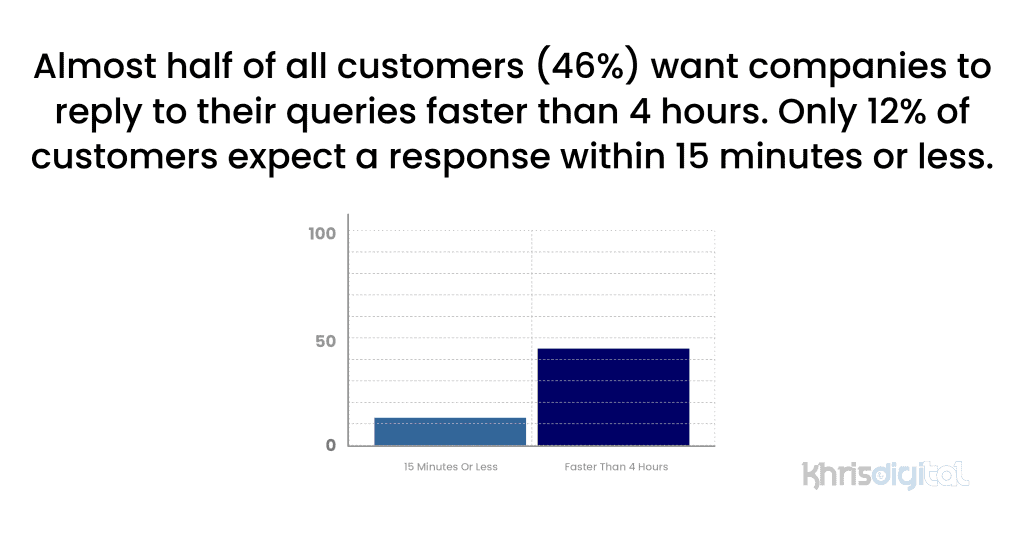
Speed has become a core part of the customer experience. People don’t just want fast shipping or quick checkouts; they also want rapid support.
Slow responses make customers feel ignored and unimportant, which often pushes them straight into the arms of a competitor.
You don’t always have to solve the problem instantly, but even a quick acknowledgment shows customers that you care and that their time matters.
11. 11% of consumers expect businesses to respond to their reviews the same day, while 34% are satisfied with a response within 2–3 days.
(AmplifAI)

How you handle reviews, good or bad, shows future customers exactly how much you care. Fast responses build trust, show accountability, and prove that your business listens.
Slow or non-existent responses, on the other hand, can signal that customers aren’t a priority. Acknowledging feedback quickly, especially public feedback, can turn critics into fans and lifelong promoters.
12. 89% of customers are more likely to make another purchase after a positive service experience.
(Salesforce)

If you want customers to buy from you again, the secret is to give them a great experience the first time. Helpful, respectful, fast, and human service builds emotional loyalty, and emotional loyalty leads to repeat business.
13. 75% of customers are willing to overlook a company’s mistakes if they receive satisfactory customer service.
(AmplifAI)

Mistakes happen, even for the best companies. When customers feel heard, respected, and taken care of, they’re much more likely to stay loyal even if something initially goes wrong.
Quick apologies, genuine empathy, and real solutions can turn a potential disaster into a relationship-building moment. Companies that handle issues well strengthen their bond with customers.
14. 33% of consumers will switch brands after just one bad experience.
(PwC)

In today’s world, one bad experience is all it takes.
There’s not much room for second chances anymore. Customers have endless options at their fingertips, and if they feel mistreated, ignored, or frustrated even once, many will not hesitate to leave and likely will not come back.
This is a sharp reminder that every customer touchpoint matters. Whether it’s a glitchy checkout, a rude agent, or a delayed response, even minor missteps can cost you loyal customers and future revenue.
15. 59% of customers will abandon a brand after just one poor experience.
(PwC)
That’s more than half of your customer base, gone, from a single misstep. Whether it’s poor service, a confusing website, a delayed delivery, or a rude response, today’s customers have little patience and many alternatives.
They’re not waiting for a brand to fix things; they’re moving on. Every interaction, no matter how small, is an opportunity to build loyalty instantly or lose it.
16. 86% of buyers are willing to pay more for a great customer experience, but 32% would leave a brand they love after just one bad experience.
(PwC)
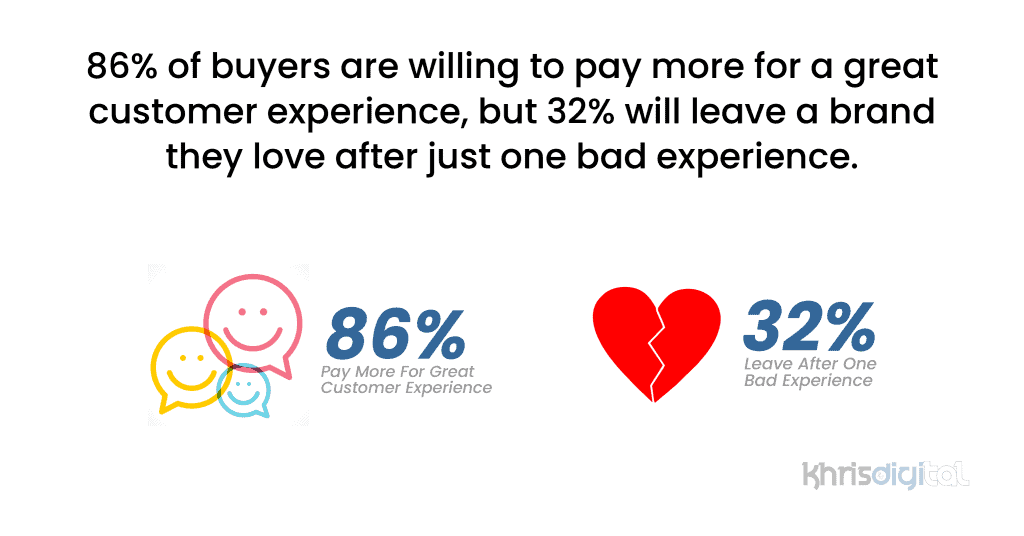
Excellent customer experience directly impacts what customers are willing to spend. This stat proves that experience is now just as necessary, if not more, than product or price.
People will pay for convenience, empathy, and trust. But loyalty is fragile, and once it’s broken, it’s complicated (and expensive) to rebuild.
17. 58% of customers say they would never use a company again after a negative customer service experience.
(PR Newswire)
A bad customer service experience can cost a customer for life. That’s brutal. But it’s also reality. In a world where choices are endless, one bad call, one rude email, or one unresolved issue is enough for a customer to walk away permanently.
If you want to grow sustainably, it’s not enough to close deals, you have to care for the customers you already have every single time.
18. 73% of consumers will switch to a competitor after multiple bad experiences.
(Zendesk)

Customers are patient but only up to a point. It’s not always the first slip-up that sends them packing but repeated disappointments quickly add up.
With slow service, unanswered questions, and rude interactions, customers may give you a second or third chance, but eventually, they’ll walk. And when they do, they’re not just leaving quietly, they’re often switching to a competitor they feel treats them better.
19. 79% of consumers would switch to a different company if they found out it offered a better customer experience.
(Zendesk)

Customer loyalty today is fragile and highly competitive.
Customers are ready to move if they believe another company will treat them better, respond faster, or make things easier. And if your experience isn’t top-notch, you’re risking your customers daily.
20. Three in four consumers say a bad interaction with a business can ruin their day.
(Zendesk)

Customer service impacts how people feel on a personal level. One frustrating phone call, a cold email, or an unhelpful response affects the customer’s mood, emotions, and trust. That’s a lot of weight for every interaction to carry.
Empathy, patience, and genuine care are necessary to build lasting customer relationships. People remember how you made them feel, and not just what you sold them.
21. Over half of all consumers feel increasingly stressed and exhausted when dealing with customer support.
(Zendesk)
For many customers, seeking help feels less like solving a problem and more like adding a new headache. It all wears people down with long wait times, confusing processes, and being bounced between agents. Instead of feeling cared for, they feel drained.
And that emotional exhaustion shapes how customers see the entire brand. The companies that simplify support, empower their agents, and make every interaction easy and human will be the ones customers want to stick with.
22. Consumers give companies an average of 2.2 chances before switching to a competitor.
(Hyken)
Customers are patient but only up to a point. This means you don’t have endless opportunities to fix mistakes. If the first experience is bad and the second isn’t much better, most customers won’t bother giving you a third shot, they’ll move on.
23. Six in ten customer service agents say a lack of consumer data often leads to negative experiences.
(Zendesk)
When agents don’t have access to key details such as a customer’s history, preferences, or previous issues, they’re left to guess. That slows everything down, creates frustration, and makes customers feel like they’re starting from scratch every time they reach out.
The more your agents know, the faster they can help, the more personal they can be, and the better the overall experience will feel. Customer service without context is guesswork.
24. Only two negative experiences are enough to cause most customers to abandon a brand.
(Emplifi)
In today’s competitive market, patience is thin, and loyalty is fragile. You might get away with one mistake, but a second one often seals the deal. Two strikes usually mean you’re out, whether it’s poor support, delayed deliveries, or confusing communication.
Every interaction is a new chance to strengthen trust or chip away at it. With so many alternatives available, customers won’t stick around hoping you’ll get it right on the third try.
25. Over half of customer service agents believe their organization’s service approach can directly cause negative customer experiences.
(Zendesk)
It’s not always the agents who are the problem, sometimes, it’s the system they’re stuck in.
Outdated systems, rigid scripts, lack of flexibility, and slow internal processes can leave agents powerless to help customers truly. Even the best-intentioned rep can’t deliver excellent service if the structure around them is broken.
Empowering agents with better tools, more autonomy, and customer-first policies makes their jobs easier, dramatically improving how customers feel after every interaction.
26. Four in ten customer service agents say customers become angry when they can’t complete tasks on their own.
(Zendesk)
Today’s customers want speed, simplicity, and control. Whether resetting a password, tracking an order, or updating account info, customers expect to handle basic issues independently without waiting on hold or navigating a maze of support channels.
Clear FAQs, helpful chatbots, intuitive apps, and easy-to-use websites empower customers to solve minor problems quickly and reserve agent support for more complex issues.
27. Three in ten customer service agents cannot reliably access customer information, leading to irritated customers.
(Zendesk)
Imagine calling for help, and the agent you’re speaking with knows nothing about your history. When agents are flying blind, everything takes longer.
Customers are forced to repeat themselves, re-explain their problems, and relive their frustrations, all of which add up to a terrible experience.
If you want fast, personalized, practical support, you must equip your teams with complete, easy-to-use customer profiles at their fingertips. Without the right information, even the best agents cannot deliver the kind of service today’s customers expect and demand.
28. 60% of consumers have purchased from a brand solely because they expected excellent customer service.
(Zendesk)

Sometimes, it’s not the product that wins the customer, it’s the promise of excellent service. In today’s competitive market, people are shopping for experiences.
If they believe they’ll be treated well, heard quickly, and supported correctly, they’re much more likely to hand over their money, even if the price is a little higher or the product isn’t the cheapest.
Your reputation for caring about people can often close the sale before your competitors even get a chance.
29. 87% of consumers trust a company more when it provides an excellent customer experience.
(Hyken)
Trust isn’t built with slogans or flashy ads but through how you treat people. Every smooth transaction, every helpful conversation, and every solved problem strengthens the bond between a business and its customers.
Over time, this trust turns into loyalty, higher spending, and valuable word-of-mouth referrals.
30. “Customer-obsessed” organizations report 41% faster revenue growth compared to companies that aren’t focused on customer experience.
(Forrester)

There’s a real payoff for putting customers at the center of everything you do. Being customer-obsessed means embedding customer care into every decision, product, and interaction.
It means knowing that happy customers are the engine behind your business growth. Companies that listen, adapt, and constantly look for ways to serve better attract new ones faster than their competition.
31. Two-thirds of consumers who feel a business cares about their emotions will likely become repeat customers.
(Zendesk)
Customers remember how you made them feel. It’s about empathy, understanding, and making people feel seen and valued. When a company treats customers like real people, it creates emotional loyalty that’s much stronger than simple satisfaction.
Businesses that lead with empathy and train their teams to tune into customer emotions will build relationships that last longer and are far more profitable than those that don’t.
32. 85% of consumers will go out of their way to switch to a company with better customer service.
(Zendesk)
Better service actively attracts new ones. This means people are willing to drive further, pay more, or change their habits just to be treated better.
Good service is a competitive weapon. The companies that go the extra mile for customers don’t steal business from brands that don’t.
33. Customer-obsessed organizations report 51% better customer retention compared to those that aren’t customer-focused.
(Forrester)
Being “customer-obsessed” directly impacts the bottom line. When a company makes customers the center of everything, people feel valued, respected, and understood.
When customers feel that way, they stay longer, spend more, and become powerful brand advocates. If you want long-term growth, you need customers who never want to leave you.
34. 13% of dissatisfied customers will tell 15 or more people about their bad experience.
(American Express)

A bad experience doesn’t just end with one unhappy customer, it spreads fast. In today’s connected world, those 15 people could easily become hundreds (or thousands) if that story is shared online. Bad news travels faster than good news, and it sticks.
One unresolved complaint can damage your brand’s reputation beyond the original customer. Every bad experience you fix is a potential fire you put out before it spreads.
35. It takes 12 positive experiences to make up for one unresolved negative experience.
(Zendesk)
One bad experience carries a heavy price. That’s a huge uphill battle. No matter how many good moments you create afterward, that one bad memory lingers and it sticks in customers’ minds much longer than the positive ones.
Rather than trying to win customers back after a mistake, it’s smarter and cheaper to deliver consistently excellent service and fix issues quickly the first time they happen. Every interaction is a chance to either strengthen trust or seriously damage it.
36. 91% of unhappy customers will leave a brand without ever complaining.
(HubSpot)
If you think “no complaints” means “no problems,” think again. Most customers won’t bother telling you they’re frustrated. They won’t ask for a manager or write an angry email, they’ll quietly switch to a competitor. And you may never even know why.
That’s why it’s critical to proactively check in with customers, look for early warning signs, and make it incredibly easy for them to share feedback.
37. 70% of customers believe a company cares more about profits than their needs after a bad experience.
(Salesforce)
When service goes wrong, it damages trust at the core. That’s devastating. It turns a service failure into something personal. A feeling that the brand doesn’t value them, only their money. And once that belief sets in, it’s challenging (and expensive) to rebuild.
You remind customers that they matter when you show genuine care, empathy, and quick action. When you don’t, you reinforce their worst fears and lose them for good.
38. 78% of customers say resolving their issue quickly is the most critical factor in a positive customer experience.
(Salesforce)
Speed matters a lot. When customers seek help, they want to feel like their time is respected and their issue is important. Every extra minute they wait or repeat themselves chips away at trust and satisfaction.
The faster and smoother you resolve problems, the more customers will feel valued and the more likely they are to stay. In customer service, fast is the new friendly.
39. The average customer service chat response time is 2 minutes, but customers expect replies within 45 seconds to feel satisfied.
(SuperOffice)

When customers start a chat, they expect instant engagement. That tiny gap between expectation and reality might seem small, but it feels huge in the customer’s mind. Waiting even one extra minute can create frustration and damage the whole experience.
Quick replies build confidence and show customers you respect their time. Speed in chat support is the baseline for delivering a standout customer experience.
40. 67% of customers say faster response times significantly improve their satisfaction with a company.
(Zendesk)
If you want happier customers, respond faster. Fast replies make people feel heard, valued, and essential. Slow responses, on the other hand, can leave customers feeling ignored and frustrated, despite how great your product or service might be.
You don’t always have to have the perfect answer right away, but showing that you’re paying attention (and care enough to respond quickly) goes a long, long way.
41. 42% of customers have left a business because they were frustrated by rude or unhelpful staff.
(Zendesk)
Sometimes, it’s not the product or price that drives customers away, it’s the people. It doesn’t take much. A cold tone, a dismissive comment, or a lack of basic courtesy can instantly turn a loyal customer into a lost one.
And the worst part? Most customers won’t complain; they’ll walk away and never return. A smile, patience, and willingness to help are small human gestures that keep customers returning.
People remember how they’re treated, and they spend their money where they feel respected.
42. 81% of consumers say a positive customer service experience makes them more likely to make another purchase.
(Salesforce)
Want to turn one-time buyers into repeat customers? Deliver a fantastic customer service experience. It’s about fixing problems and creating moments of trust, ease, and genuine care.
When customers feel valued and respected, they spend more, return more quickly, and often bring others. Every friendly email, helpful chat, and fast resolution strengthens the bond between your brand and your customers.
43. 73% of consumers say customer experience is a key factor in their purchasing decisions, even more so than price and product quality.
(PwC)
Think about that for a second. You could offer the lowest price and the shiniest features, but if people feel ignored, rushed, or frustrated, they’ll happily walk away.
Experience is the new battleground, and it’s emotional. It’s how customers feel when interacting with your support team, website, emails, and return process.
Every touchpoint adds up. If companies want loyalty and word-of-mouth love, they can’t just focus on having the best stuff or deals. They have to feel the best to buy from.
44. 90% of customers expect a consistent experience across all channels, including online, mobile, and in-person interactions.
(RWS)
Trust takes a hit if customers get top-notch service online but chaos in-store. Or if your app is sleek but your phone support sounds like 1997, they notice. People move fluidly across platforms now; they don’t think in “channels”, they believe in “experiences.”
And they expect your brand to keep up.
Businesses that nail this build loyalty without even having to ask for it. Those that don’t? They create friction, frustration, and a perfect excuse for customers to check out the competition.
45. 70% of customers believe that companies should collaborate on their behalf to provide seamless service.
(Salesforce)
Customers don’t care about how your company is structured. They don’t want to hear, “Sorry, that’s a different department.” They expect things to work. If they call support after chatting online, they expect the new agent to know exactly what was said before.
If they walk into a store after browsing online, they expect the associate to pick up where they left off.
When collaboration is tight, service feels effortless. When it’s not? Customers feel like they’re doing your job to solve their problems. Companies that make their internal teamwork invisible to the customer win.
46. 60% of millennials surveyed expect a consistent experience from brands, whether online, in-store, or via phone.
(RWS)
And honestly? Can you blame them? This generation grew up with Amazon Prime, smartphones, and one-click everything. They don’t think of “online” and “offline” as separate worlds; to them, it’s all just shopping.
If your brand feels clunky or disconnected from one touchpoint to the next, it sticks out like a sore thumb. Worse, it feels lazy.
Companies that want millennial loyalty (and their spending power) need to ensure the experience feels like one smooth ride.
47. 64% of consumers expect companies to respond to their inquiries in real time.
(Salesforce)
Thanks to instant messaging, live chat, and same-day delivery, people are used to getting what they want without waiting, and that expectation has fully bled into customer support.
If a customer has a question or hits a snag, they’re looking for help when they ask for it, not hours later when their frustration has already boiled over.
Brands that can meet customers where they are, when they need it, win trust almost effortlessly. Brands that lag? Well, they get ghosted. In today’s market, speed is the basic entry price.
48. 74% of consumers say that word-of-mouth is a key influencer in purchasing decisions.
(Ogilvy)
Customers trust their friends, family, and even strangers online more than they trust a polished marketing campaign. And it makes sense. A five-star review from a buddy or a glowing TikTok testimonial feels authentic in a way no corporate slogan ever will.
The kicker? Word-of-mouth is outside your control. You can’t buy, fake, or spin it. You earn it by delivering incredible experiences consistently. When you wow customers, they naturally become your hype squad.
49. 88% of consumers have been influenced by an online customer service review when purchasing.
(Zendesk)
People are scouring Google, Yelp, Trustpilot, Reddit — anywhere they can find real stories from real people about how your team treats customers when things go sideways.
One bad review about being ignored or treated poorly could cost hundreds (or thousands) of dollars.
On the flip side, glowing reviews about helpful, fast, and human support build instant trust and get people to hit “buy.” In today’s review-driven world, your customer service reps are public-facing brand ambassadors. And the internet is always watching.
50. 67% of consumers will likely recommend a company that provides exceptional service.
(HubSpot)

Want free marketing? Start with exceptional service. When someone has a standout experience, they remember it. They talk about it. They tweet it, text it, and tell their group chat.
And that kind of organic, unpaid advocacy? It’s gold. It carries more weight than any ad ever could. Companies investing in service turn customers into fans, promoters, and loud cheerleaders.
51. 77% of customers will likely share their positive experiences on social media.
(American Express)
That means every single significant interaction you deliver has the potential to turn into public praise, the kind of publicity money can’t buy. And let’s be honest, people love talking about good service when it surprises them.
And once it’s out there, it spreads. One glowing post can reach hundreds or thousands of people who now see your brand as one that gets it. So no, social isn’t just a risk zone for complaints. It’s also a massive opportunity for love, but only if you earn it.
52. 94% of consumers who give a business a “very good” rating are likelier to recommend it.
(Qualtrics)
When people walk away impressed — not just satisfied, but genuinely happy — they want others to feel it too. They become vocal fans, and suddenly, your best marketing isn’t coming from your team… it’s coming from your customers.
The takeaway? “Good enough” won’t move the needle. But when you consistently deliver that very good, five-star, above-and-beyond service, you’re enrolling customers into your unofficial sales team. And they’re way more persuasive than any paid ad.
53. 50% of customers say that after a positive experience with a company, they are more likely to post a review or recommend the brand.
(Salesforce)
That might not sound huge at first glance, but think about it, every two great experiences could potentially lead to a public shoutout or a personal referral. That’s powerful. And it’s completely organic.
This doesn’t happen with “meh” service. It only occurs when a customer walks away thinking, “Wow, they cared.” So, if you’re looking to grow without throwing money at ads, start with how you treat people. That’s what sparks the ripple effect.
54. 68% of customers leave a review after a positive experience, and 29% do so after a negative experience.
(BrightLocal)
There’s a common myth that only angry customers leave reviews, but the data says otherwise. People want to highlight good service. Give them a fast response, a helpful human, or a thoughtful touch, and many are ready to hit that “write a review” button.
The downside is that your best marketing moments might go uncollected unless you make it easy to share. So, while it’s important to handle complaints, it’s just as important to ask for praise when it’s earned.
55. Companies that excel in customer experience grow 4–8% above their market average.
(Bain & Company)

Excellent service builds loyalty and fuels referrals. It keeps customers coming back without needing constant discounts or gimmicks.
Think about the brands you love most, odds are, it’s not just what they sell but how they make you feel whenever you interact with them.
56. 70% of consumers are more likely to recommend a company that responds quickly to their inquiries.
(Twitter)
A quick reply shows that a company respects your time, values your business, and has its act together. It builds trust, even before a solution is found.
Conversely, slow responses, or worse, silence, can turn a small question into a considerable frustration. And that frustration? It doesn’t stay private.
But when customers feel heard right away, they’re impressed. That’s when they start telling others, “You should check these guys out.” So, if you want referrals, start by showing up fast.
57. 45% of customers will switch brands if a company fails to measure their satisfaction effectively.
(Forrester)
In today’s customer-first world, people expect to be heard. They want to know that their feedback matters. Failing to ask, follow up, or act on customer input sends the message that their experience isn’t a priority.
Brands don’t usually lose customers over one major blowup, they lose them through small, quiet signals of neglect. So if you’re not checking in, listening, and doing something with what you hear? Your customers are already eyeing the exit.
58. Businesses tracking CSAT scores have a 33% higher retention rate.
(HubSpot)
CSAT(Customer Satisfaction) surveys are like a health check for your customer experience. They catch problems early, show you what’s working, and give you a roadmap to improve. And customers notice.
When they’re asked for feedback and then see you make changes based on it, it deepens trust.. On the flip side, flying blind and assuming customers are happy? That’s how you quietly bleed them to competitors.
59. 60% of companies that actively measure NPS report faster growth than their competitors.
(Bain & Company)
NPS (Net Promoter Score) gives you a simple but powerful pulse on how customers feel. When you stay plugged into that feedback, you can spot problems early, double down on what’s working, and create experiences that turn customers into loyal fans.
Companies that measure NPS are using it to fine-tune their entire operation. It’s like having a real-time scoreboard for customer loyalty. Because when you know precisely how your customers feel, you don’t have to guess your next move.
60. 88% of high-performing companies use CSAT as a primary measure of customer satisfaction.
(Zendesk)
Why? Because CSAT gives them real, actionable insights. It’s quick, direct, and cuts through the noise. If you’re serious about delivering an experience that keeps customers loyal and spending, you can’t just assume you’re doing a good job; you must ask and track it.
The best companies aren’t guessing how their customers feel; they’re constantly checking in, adjusting, and improving based on honest feedback. It’s part of why they stay ahead.
61. 72% of customers expect a response within 30 minutes of reaching out, making FRT a critical factor for customer satisfaction.
(SuperOffice)
It’s not a resolution, not a detailed fix, just a sign that someone’s listening. This makes FRT (First Response Time) one of the biggest drivers of customer satisfaction today. Fast acknowledgment shows customers you value their time and take their problems seriously.
Even if it’s a simple “We’re on it!” message, it buys you trust and patience. But delay too long, and frustration sets in fast, especially when the instant gratification of texting, live chat, and real-time everything trains customers.
62. 50% of companies that track NPS have been able to increase customer referrals by 10% or more.
(Retently)
Want more referrals without begging or bribing? Start tracking your NPS. NPS is a window into how likely your customers are to talk about you in real life.
And when you consistently measure it, you can spot the patterns: What’s making people rave? What’s holding them back?
High-performing companies use NPS feedback like a GPS. They course-correct fast, fix friction points, and double down on what customers love. The result? Happy customers are staying longer, and they’re bringing their friends.
63. 68% of customers who receive a response within one hour are more likely to become repeat customers.
(Harvard Business Review)
One hour! That’s the window where trust is built, or lost. It’s about making customers feel seen, heard, and prioritized.
A quick reply says, “We’ve got you.” Radio silence says, “You’re not that important.” And today’s customers? They’re not going to chase you down for attention; they’ll move on to a brand that’s quicker to care.
If you’re serious about boosting retention, don’t just think about loyalty programs or fancy marketing. Think about that first hour. Nail it; you’re already halfway to creating a customer for life.
64. A 10% increase in NPS can lead to a 6–7% increase in revenue.
(Medallia)
That’s real, tangible growth tied directly to your customers’ happiness and loyalty. When more people are willing to recommend you, they are talking and buying more, sticking around longer, and bringing new customers.
It’s a ripple effect that shows up directly in your bottom line.
And the beauty is, you’re not spending more on ads or heavy discounts to get it. You earn it by delivering better service, experiences, and emotional connections.
65. 75% of customers are more likely to purchase from a company that knows their name and purchase history and recommends products based on that information.
(Accenture)
People don’t want to feel like just another transaction; they want to feel seen. And when a brand shows it knows them by offering thoughtful, tailored suggestions, it builds a connection that drives absolute loyalty.
Think about it: when you walk into a local coffee shop, and they already know your order, it feels good, right?
Same idea here. Customers reward businesses that pay attention. Companies that treat personalization as a priority (and not an afterthought) are building relationships that keep customers returning.
66. 80% of consumers are more likely to purchase from a brand that offers personalized experiences.
(Epsilon)
That could mean customized product recommendations, emails that make sense for their interests, or support that remembers their past issues. Customers don’t want to dig through a mountain of generic options. They want to feel like you get them.
When brands deliver that sense of “Hey, we made this just for you,” it triggers loyalty, increases spending, and makes switching feel like a bigger hassle.
67. 76% of customers become frustrated when companies fail to offer personalized interactions.
(McKinsey)
In a world where Netflix knows what you want to watch next and Spotify builds you custom playlists, customers expect brands to remember their basic preferences at least.
It feels lazy when they get hit with one-size-fits-all messaging, irrelevant product suggestions, or have to repeat their history to three different agents. It says, “We don’t care who you are.”
And that’s enough to push even loyal customers toward brands that make them feel seen and valued.
68. Companies that excel at personalization can see a 10–15% revenue increase.
(McKinsey)
When you tailor experiences to what your customers want by showing them products they’re likely to love, remembering their preferences, and making their journey smoother, they reward you with bigger baskets, more frequent purchases, and long-term loyalty.
It’s the difference between saying, “Here’s our stuff” and “Here’s your stuff.” The brands that take the time to get personal are the ones that customers stick with and spend more with.
69. 63% of consumers expect personalization as a standard service.
(Salesforce)
This means that if your emails, recommendations, and customer service feel generic, you’re already starting to fall behind. Today’s customers are used to brands remembering their names, preferences, and past purchases and even anticipating their needs.
And when a company treats them like strangers, it feels outdated, even disrespectful. To stay competitive, brands must treat personalization like electricity: invisible, seamless, and essential to everything else working.
70. 77% of customers have chosen, recommended, or paid more for a brand that provides a personalized service experience.
(Forrester)
It proves that when you take the time to treat customers like individuals and not faceless transactions, they notice and reward you for it. Personalization builds emotional loyalty, which is way stronger (and stickier) than a discount or a coupon ever will be.
It’s what turns occasional buyers into lifelong fans. It makes someone walk past a cheaper option to stick with you.
71. 48% of customers spend more when their experience is tailored to their needs.
(Segment)
Buying feels effortless when you show people exactly what they want. Personalization removes friction, builds trust, and creates that feeling of, “This brand gets me.”
And when people feel understood, they’re not just buying the bare minimum. They’re upgrading, adding extras, and sticking around for the long haul.
72. Brands that excel at personalization are 71% more likely to report improved customer loyalty.
(Deloitte)
And that’s not just about sending birthday emails or throwing someone’s name in the subject line. It’s about creating experiences that feel tailored, thoughtful, and genuinely relevant at every touchpoint.
When customers feel like you know them, what they like, what they’ve bought, what they might need next, it builds trust fast. And trust is the glue that keeps them coming back, even when competitors come knocking.
73. 6 in 10 consumers believe businesses should use the data they collect about them to personalize their experiences.
(Zendesk)
People aren’t blind to companies tracking their behaviors, preferences, and purchase history. But what really frustrates them is when that information is wasted.
If a brand knows what you love, what you’ve bought, and what you’ve clicked on — yet still sends irrelevant offers or forces you to start from scratch every time — it feels lazy, even disrespectful.
74. Nearly 70% of organizations consider personalizing the CX a top priority.
(Ascend2)
Customers today expect brands to meet them where they are, know what they want, and make the entire journey feel tailor-made. Companies that treat personalization like a “nice extra” are getting left behind fast.
The leaders are building strategies, investing in tech, and training teams around the idea that no two customers are the same.
75. Brands are increasing their personalization budget by 29% this year compared to last year.
(Deloitte)
Businesses realize that blanket marketing and generic service don’t cut it anymore. Customers expect tailored recommendations, relevant content, and experiences designed for them.
And brands willing to invest more in personalization are betting on higher retention, bigger order values, and stronger customer loyalty.
76. 62% of consumers agree that personalized recommendations are better than general ones.
(Zendesk)
When a brand nails the recommendation by suggesting the right product at the right time, based on your actual behavior, it feels effortless. It makes buying easier, and it builds trust. But when suggestions are random, irrelevant, or automated junk? It’s just noise.
Today’s customers are savvy. They know what a good recommendation looks like and reward brands that get it right with more clicks, purchases, and loyalty.
77. 77% of business leaders believe that deeper personalization leads to customer retention.
(Zendesk)
The more relevant your messaging, recommendations, and support, the more likely customers are to stick with you even when other options are cheaper or flashier. Leaders are waking up to the fact that personalization is a strategy.
A well-executed personalized experience makes people feel emotionally connected to a brand. And when that connection is strong, so is the loyalty.
78. 79% of business leaders believe that service data is invaluable to driving personalization efforts.
(Zendesk)
Every support ticket, chat transcript, and feedback form contains insights about customers’ wants, frustrations, and expectations. Smart companies are capturing those interactions and using them to create better, more tailored experiences.
It’s how you move from generic messaging to “Hey, we thought this might be exactly what you need.” When brands mine service data for patterns and preferences, personalization becomes more precise.
79. 6 in 10 consumers notice and appreciate when they receive personalized recommendations.
(Zendesk)
That means the time, tech, and thought you put into tailoring suggestions is making a real impact. Customers don’t just want relevance; they value the effort that goes into providing it. It makes them feel seen, respected, and more connected to the brand.
And that little nod of recognition — “Hey, this is helpful” — can be the difference between a browser and a buyer. So, if you’re wondering whether personalization matters to your audience, the answer is a loud yes.
80. 66% of business leaders believe personalization leads to lower customer acquisition costs.
(Zendesk)
When you nail personalization, you’re not shouting into the void, hoping someone hears you. You’re speaking directly to the right people with the right message at the right time. That means fewer wasted ads, higher conversion rates, and warmer leads from the jump.
Plus, personalized experiences drive referrals, repeat business, and brand buzz, which bring in new customers without you having to spend big to chase them down.
81. Nearly two-thirds of consumers expect more personalized service with AI.
(Zendesk)
Customers hold you to a higher standard if your brand uses AI behind the scenes. They assume the tech instantly knows who they are, what they’ve bought, what they like, and how to help.
Generic responses or irrelevant recommendations that fall flat feel like a failure because expectations are so high. With the right AI tools and innovative data use, brands can deliver lightning-fast, deeply personalized experiences at scale.
82. 91% of CX Trendsetters believe AI can effectively personalize experiences.
(Zendesk)
With AI, brands can anticipate needs, serve up hyper-relevant content, and adapt in real-time, something human teams alone could never do fast enough.
The trick, of course, is using it right. The best companies blend AI’s precision with a human touch, creating a service that feels personal, not robotic. If you want to play at the top of your industry, following what the CX pioneers are doing with AI is the blueprint.
83. Only 22% of CX Traditionalists actively invest in using AI to personalize the customer experience.
(Zendesk)
That’s a massive gap,, and a risky one. These traditionalists are missing the chance to meet rising customer expectations and stay competitive.
Meanwhile, their more agile rivals are using AI to deliver faster, smarter, more tailored service and they’re pulling ahead fast.
84. 56% of CX Trendsetters invest in AI to personalize the customer experience.
(Zendesk)
They understand that AI is about delivering faster, more innovative, more relevant experiences that feel custom-built for every customer. By investing early, they’re gaining the agility and insight that traditional strategies can’t compete with.
They’re building it now. And the gap between them and the slow adopters? It’s growing by the day. If personalization is the new battleground, AI is the sharpest tool in the box, and the best are already using it.
85. 80% of companies plan to increase their level of investment in CX.
(Zendesk)
Businesses have finally realized that product and price alone aren’t enough. What keeps customers returning (and bringing their friends) is how they feel when interacting with your brand.
So, it’s no surprise that the most innovative companies are pouring more into better tools, training, tech, and personalization strategies. Because in today’s competitive market, a standout customer experience is your most significant differentiator.
86. 35% of companies plan to invest more in adding service across channels.
(Zendesk)
Today’s customer expects consistency whether they’re on your website at 9 a.m. or DMing your Instagram at midnight.
And when they get bounced between disconnected platforms or have to repeat themselves five times, that loyalty meter starts to drop fast. The brands making omnichannel support a priority are more trustworthy.
87. 80% of organizations expect to compete with each other based on CX.
(Gartner)
When everything else starts to look the same with similar features, pricing, and promises, experience sets a brand apart. It’s how fast you respond, how easy it is to get help, and how your customers feel when interacting with you.
That emotional connection is your competitive edge.
Because when the experience is unforgettable (for the right reasons), customers become your loudest advocates.
88. Only 3% of companies are currently customer-obsessed and put their customers’ needs front and center.
(Forrester)
This means that while everyone says they care about customers, very few actually walk the talk. Being customer-obsessed is about designing products, policies, processes, and decisions based on what’s best for the people you serve.
It takes real commitment, real humility, and real action.
89. 62% of customers think experiences should flow naturally between physical and digital spaces.
(Zendesk)
There’s no “online vs. offline” to today’s customer. They want to browse online, buy in-store, return via the app, and get consistent, smooth service. And when that doesn’t happen? It feels disjointed.
Inconsistent experiences across channels break trust, create friction, and give customers a reason to try elsewhere.
90. 70% of customers expect anyone they interact with to have the full context of their situation.
(Zendesk)
Customers assume your team has the tools and systems to stay connected. So when they get transferred and have to start from scratch, it feels like the brand just hit reset on the relationship. It’s frustrating, it’s inefficient, and it screams disorganization.
Conversely, when a rep picks up the conversation exactly where it left off. Brands that get this right win loyalty without even trying.
91. 79% of customers expect to interact with customer service representatives through social media channels.
(Statista)
That means they’re not going to your website, finding the “Contact Us” page, and waiting two days for a response. They’re tagging you, DMing you, and expecting instant support, all out in the open.
And when brands don’t show up there? It feels like they’re ignoring the space where customers spend their time. The stakes are higher, too. Social service is fast, visible, and can go viral for better or worse.
92. 60% of consumers say that quick resolution times are critical to their experience with a company.
(Forrester)
Every minute a problem drags on, frustration builds, trust fades, and loyalty takes a hit. Conversely, when a brand jumps in and solves the issue quickly, it creates a sense of relief and respect, even if the original problem was annoying.
Speed turns a bad moment into a chance to impress. So, if you’re tracking metrics, don’t just watch FRT (first response time), watch resolution time like a hawk.
93. 66% of consumers expect brands to understand their unique needs and expectations.
(Salesforce)
People want to feel like more than just a number. They want their past purchases, support history, and behavior to mean something.
When brands deliver that kind of intuitive, personalized touch, they build loyalty fast. But when the experience feels one-size-fits-all, it sends a clear message: “We don’t know you, and we’re not really trying.”
94. 57% of customers will abandon a brand if they find a better experience elsewhere.
(Salesforce)
When a competitor delivers faster responses, more personalized care, or a smoother overall interaction, customers won’t hesitate to switch. In a market with endless options, loyalty is earned by consistently exceeding expectations.
A slip in service can send customers scurrying to a brand that listens and adapts. By continually upping your game and keeping the customer experience top-notch, you lock in loyalty and stay ahead of the competition.
95. 89% of consumers want to connect with brands through different channels and expect a seamless transition between them.
(Khoros)
That means no re-explaining the issue every time they switch from a chatbot to a human. There are no repeating order numbers just because they went from Instagram DMs to a support ticket.
They want continuity. They want context. And they want it all to feel like one smooth conversation, not a messy handoff. The brands that make this work are the ones customers stick with because they make it easy.
96. 67% of customers prefer self-service options over speaking to a company representative.
(Zendesk)
It’s not that people hate humans; it’s that they love control. They want speed, simplicity, and the freedom to fix things without being put on hold.
And when self-service is done right, it builds confidence and trust. But if it’s clunky or half-baked? Customers will bounce fast.
97. 58% of consumers feel that companies don’t understand their needs well.
(Salesforce)
People are craving experiences that feel tailored, thoughtful, and human. But when messaging feels off, service is generic, or offers are irrelevant, it sends one loud message: “We’re not paying attention.” Customers want brands to know what matters to them.
When that alignment is missing, trust erodes. The sad part? Many companies think they’re doing personalization well, but clearly, the customer doesn’t agree.
98. 54% of millennials are willing to spend more on a company that offers high customer service.
(Microsoft)
Millennials may love a good deal but love excellent service even more. And that matters because millennials are the largest group in the workforce, with growing buying power and sky-high expectations.
For them, convenience, respect, and fast, friendly help are baked into what makes a brand worth supporting.
If you make it easy to get help, remember their preferences, and treat them like a person? They’ll spend more, stay longer, and tell their friends. But does your service feel like a chore? They’ll peace out fast, even if you’re cheaper.
99. 74% of customers say they’re likelier to stick with a brand that understands them and delivers relevant communication.
(Business2Community)
Want loyalty? Start by showing your customers you get them. That means ditching the one-size-fits-all blasts and leaning into timely, personal, and valuable messages.
When brands speak to customers like individuals with the right tone, at the right moment, about the right things, it builds a kind of quiet loyalty that no discount or flash sale can touch.
100. 67% of consumers have used social media platforms like Twitter, Facebook, or Instagram for customer service needs.
(JDPower)
When email replies take too long or phone lines are clogged, tagging a brand or shooting a DM is the most direct route.
But if your social team isn’t equipped to handle support, or worse, doesn’t respond, you’re leaving frustrated customers on full display.
101. 88% of customers say they are less likely to buy from a brand that leaves complaints on social media unanswered.
(The Real Time Report)
And honestly, can you blame them? When a brand doesn’t respond publicly, it sends a loud, clear message: “We don’t care.” Social media is today’s customer service front desk, and it’s wide open. Everyone sees how you handle feedback, especially the negative kind.
Ignoring a complaint doesn’t make it disappear. It amplifies the frustration and shows future customers exactly what to expect (or not expect). But when you show up, respond quickly, and own the problem? You build credibility, even with the angry ones.
102. 70% of customers expect to receive a response on social media within 24 hours, while 42% expect a response within just 60 minutes.
(Sprout Social)
Customers don’t care if it’s the weekend, a holiday, or after hours if they’ve reached out on social media, they expect a prompt reply. And when they don’t get one, it feels like being left on read… by a brand.
Not a good look.
The platforms may be casual, but the expectations are anything but. Responding quickly shows you’re listening, care, and know how to operate in real-time. Ignore that window, and you’re irrelevant.
103. 80% of consumers use social media to engage with brands and seek support.
(HootSuite)
Social media is where your customers hang out, and it’s where they expect you to be. And they’re not separating “social” from “service” anymore, they see it as one, seamless interaction.
That means brands can’t afford to treat social as just a marketing megaphone.
It’s a two-way street. When you respond, engage, and solve problems where people already are, it shows you’re listening. But if you’re absent or silent? That’s a trust gap.
104. Social media response times can impact customer satisfaction, with 65% of consumers reporting that fast response times improve their opinion of a brand.
(Khoros)
That’s huge. Fast replies send a message: “We see you. We care. We’re on it.” And in a space where customer experiences play out in public, that kind of responsiveness can shape how everyone sees your brand.
Whether it’s a simple thank-you, a complaint, or a cry for help, how fast you respond can turn a one-off interaction into a loyalty moment. The takeaway? Social media is about being present and fast. Because when you show up quickly, you raise the bar.
105. 60% of customers define their customer service experience as satisfactory when they receive a quick resolution.
(Forrester)
It shows you value the customer’s time, understand their frustration, and have the systems in place to deliver.
Even the most polite interactions can feel painful when brands overcomplicate things or drag their feet. But if you solve it fast, you’ve just turned a potential headache into a moment of relief, and that relief is what builds loyalty.
106. 90% of consumers rate an “immediate” response as necessary when they have a customer service question, with 60% defining “immediate” as 10 minutes or less.
(HubSpot)
That’s the new bar. Forget 24-hour response windows or “we’ll get back to you soon” auto-replies. If you’re not replying within minutes, you’re already falling behind in their eyes.
And when a brand can’t meet that moment, it feels ignored. But if you show up fast, you instantly earn trust and show customers they matter.
107. 70% of customers expect a response from brands on social media within 24 hours, but 42% expect a reply within 60 minutes.
(Sprout Social)
In the social space, speed signals that you’re paying attention. It shows customers that their voice matters and that you’re ready to jump in and help without delay. Conversely, slow responses feel like being left on read, and nothing kills trust faster than silence.
108. Businesses that respond to customer service emails within one hour are 7 times more likely to convert a lead into a customer.
(Harvard Business Review)
When someone reaches out with a question, they’re usually on the edge of a decision. And if you jump in quickly, you catch them while the interest is hot. Wait too long, and the moment (and the customer) is gone.
A fast email reply shows you’re responsive, organized, and ready to help. These are qualities that build trust in the buying process.
109. 77% of customers view brands more favorably if they proactively seek and apply their feedback.
(Microsoft)
If you want to win customer loyalty, ask for their opinion and do something with it. It’s not just about sending a survey after a purchase, it’s about showing customers that their voice has weight.
When people feel heard, respected, and like their input leads to real change, they become more invested in your brand. On the flip side, if feedback disappears into a black hole, customers eventually stop giving it and start walking away.
110. 52% of customers believe companies need to take action on feedback provided by them.
(Salesforce)
They want to see changes, improvements, and real outcomes that reflect what they’ve shared. When that happens, customers feel valued, like they’re part of building something better. But when brands ignore feedback or treat it like a formality? It creates a disconnect.
Customers start to feel like their opinions don’t matter, and that trust erodes. Taking action on feedback is a loyalty builder.
111. 70% of customers who have a positive experience with a business after providing feedback are likelier to become loyal advocates.
(HubSpot)
It means the moment after someone gives input, either a complaint, suggestion, or praise, is a golden opportunity. If the business responds with transparency, action, or even a simple thank-you, it turns a passive customer into a potential superfan.
That’s how you build real brand advocacy by showing up when it counts.
112. Companies that actively use customer feedback for product improvements and service enhancement see a 10% increase in customer retention rates.
(Qualtrics)
When customers’ input turns into fundamental changes, they feel respected, included, and more connected to the brand. This signals that the company is evolving with its customers. And that kind of collaboration builds profound loyalty.
Conversely, if feedback disappears into the void and nothing changes, people wonder why they are bothered. When feedback fuels progress, retention becomes a natural byproduct.
113. 7% of consumers report responding to every survey, 22% respond to most, and 34% respond to some.
(Khoros)
That means even your most loyal customers are selective about when they give feedback. It’s not that they don’t care, but they’re busy, skeptical, or unsure if their voice will matter.
So what does this tell us? If you want better response rates, you need to earn their attention. Keep surveys short. Make the purpose clear. Most importantly, follow up with real action. When people know their feedback leads to change, they’re more likely to respond next time.
114. 66% of consumers say they feel more valued when their feedback is acknowledged.
(Zendesk)
Sometimes, it’s the simple things that matter most, like saying, “We heard you.” You don’t necessarily have to fix everything or agree. Just recognize it.
That tiny acknowledgment builds trust and respect faster than most companies realize. It tells customers they’re not shouting into the void. And when people feel heard, they feel valued.
115. Businesses that close the loop on customer feedback are 2.5 times more likely to retain their customers.
(Gartner)
Gathering feedback is excellent, but are you following up on it? That’s where the real magic happens. Businesses that close the loop, meaning they respond to feedback, act on it, and let customers know they did, are 2.5 times more likely to keep those customers around.
Why? Because closing the loop tells customers their input made a difference. Most companies collect feedback. Few do something with it.
And even fewer let the customer know what changed. But the brands that nail this step? They’re strengthening relationships with every follow-up.
116. 89% of customers are willing to share a positive review after a company takes action based on their feedback.
(Trustpilot)
That’s huge, and underused. Most brands are chasing reviews with discount codes and reminder emails, but they’re missing the most significant driver, which is respect.
When a customer sees their input lead to change, they feel heard, empowered, and appreciated. That’s when they tell others. That’s when they advocate.
117. 85% of companies prioritizing customer feedback see increased revenue, showing the direct financial impact of listening to customers.
(Harvard Business Review)
When you actively seek out what your customers are saying and use that insight to guide decisions, improve products, and fine-tune experiences, the results show up in your bottom line.
118. 72% of consumers believe companies that ask for feedback care more about providing good service.
(Forrester)
Asking for feedback is about showing customers you care. It tells them, “We want to improve and value your voice.” Even before any changes are made, the act of asking builds trust. It creates a two-way relationship, not just a transaction.
And in a world where most customers feel unheard, that gesture alone sets you apart.
119. Thanks to AI advancements, 85% of customer interactions will be handled without a human agent by 2025.
(Gartner)
Chatbots, self-service tools, voice assistants, and predictive systems will take the front line. And while that might sound futuristic, it’s already happening. Customers are getting faster answers, 24/7 support, and smoother resolutions without ever talking to someone.
But automation only works when it feels human enough. It backfires if it’s cold, confusing, or leads to a dead end. While AI is scaling service, how it’s done still makes all the difference.
120. 56% of companies already use AI-powered chatbots to streamline customer service operations.
(Salesforce)
They reduce wait times, free up human agents for more complex tasks, and deliver consistent answers around the clock. For customers, it means instant support. For businesses, it means faster resolution and lower operational costs.
But like all tech, chatbots only shine when built with the customer in mind. If the experience is clunky or too scripted, people will bail fast.
121. 64% of consumers prefer AI-driven instant messaging to phone support for simple questions.
(Forrester)
With AI chat, answers are fast, accessible, and often available 24/7. It puts control in the customer’s hands and eliminates unnecessary friction.
AI doesn’t need to replace human support, but should handle the easy stuff. When you let bots handle the basics, you free up your human agents to focus on what they do best: solving complex problems and building relationships.
122. Businesses implementing AI to enhance customer service report a 30% increase in efficiency.
(McKinsey)
Whether through chatbots, smart routing, or automated workflows, AI helps reduce bottlenecks, cut response times, and handle repetitive tasks without sweat. For customers, it means quicker answers and smoother experiences.
For support teams, this means less burnout and more bandwidth for complex, high-value conversations.
123. 75% of customers expect AI-powered tools to improve their experience by providing faster responses.
(HubSpot)
Whether they’re asking a basic question or checking an order status, customers don’t want to wait. They want to be helped instantly. From the customer’s perspective, AI’s promise is all about eliminating delays, avoiding long queues, and skipping the “please hold” music.
If AI doesn’t deliver at that speed, it feels pointless. But when it does, it creates a sense of ease, efficiency, and modernity that customers love.
124. 40% of businesses are planning to expand their use of AI in customer service over the next year.
(Deloitte)
From chatbots to predictive insights to automated ticketing, AI is helping brands deliver better service at scale, and free up human agents for the stuff that matters.
Companies doubling down on AI are using tech to enhance empathy by speeding up response times, reducing friction, and making every interaction feel more relevant.
125. 61% of companies believe that AI in customer service will enable them to identify valuable insights from customer interactions.
(IDC)
And they’re right. Every chat, ticket, and review is packed with signals like what customers love, what frustrates them, and what they’re asking for next, but manually sorting through all that data. Nearly impossible. That’s where AI shines.
It can scan conversations at scale, detect patterns, flag issues, and surface feedback that used to get lost in the noise.
126. AI tools that analyze customer sentiment can increase first-call resolution rates by 20%.
(SuperOffice)
Understanding customers’ feelings can be just as important as what they’re saying, and AI is making that easier than ever. By picking up on emotional cues, tone shifts, and frustration signals, AI can now guide agents.
It’s like giving your support team emotional intelligence superpowers.
127. 82% of consumers expect an immediate response when contacting brands through live chat.
(Salesforce)
Live chat isn’t just “live” in name, it has to feel live. Live chat has become the go-to channel for people who want answers fast.
Customers who open that chat box are already engaged and ready to talk. Make them wait, and you’ve missed the moment. But respond right away, and you create momentum, build trust, and often resolve issues before they become problems.
Final Thoughts on Customer Service Statistics
Customer service has evolved, and fast. What used to be about answering phones and closing tickets is now about creating seamless, emotionally intelligent, and personalized experiences at every touchpoint.
The data doesn’t lie: customers want to feel heard, helped, and valued. They expect faster responses, smoother journeys, and service that remembers who they are.
And the companies delivering that? They’re growing revenue, building loyalty, and separating themselves from the competition.
So, what now?
Use these stats as your roadmap. Audit your gaps. Prioritize what matters. Most importantly, start treating customer service like the growth engine it is. Because in the end, it’s not the brands with the best ads that win, it’s the ones with the best relationships.
Sources:
Check out my other Statistics round-up:
