


Meme marketing is quietly dominating brand engagement behind the scenes.
With memes driving 60% higher organic engagement than standard graphics, and forecasted to make up 75% of all brand engagement, they’ve shifted from optional to essential in digital strategy.
Brands that once obsessed over sleek visuals and polished copy are now embracing humor, relatability, and even a bit of chaos because memes deliver what traditional content can’t, which is a raw, fast, viral connection.
Whether you’re looking to boost engagement, grow your brand, or go viral, understanding these meme marketing statistics could be your ticket to digital dominance.
These numbers aren’t pulled out of thin air; they come from verified, reputable sources, all listed at the bottom of this article.
1. The worldwide meme market is worth $6.1 billion.
(ElectroIQ)
Memes have outgrown their humble beginnings as internet jokes. What started as quick laughs on forums has become a full-scale marketing machine powering agencies, platforms, influencers, and even merchandise empires.
Media companies are hiring meme creators. Brands are budgeting entire campaigns around viral humor. There are licensing deals, meme stock exchanges, and curated meme subscriptions.
The value comes not just from views or likes, but from cultural relevance that converts into real revenue. Memes aren’t just part of the internet anymore. They are an industry.
2. More than three billion people use social media, and 60% use it to share memes and funny content.
(Forbes)
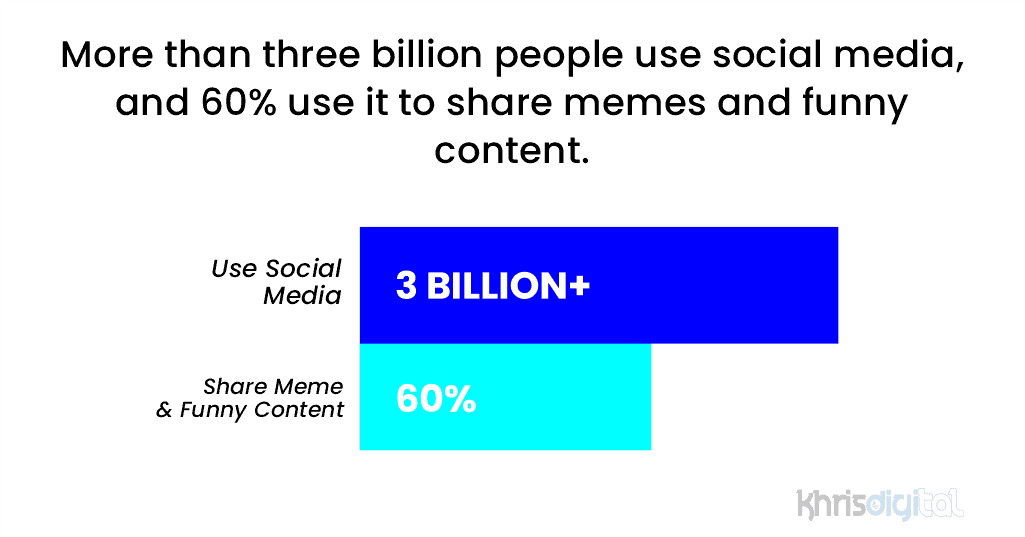
Memes are one of the most universal languages online. On social platforms, billions of people actively share humor daily.
People instinctively share content that reflects how they feel, and memes do that better than anything else. That sharing loop creates built-in virality. For marketers, this means memes have already won the attention war.
Instead of forcing branded messages into feeds, memes ride the current of what people are already doing. When content is funny, it travels.
3. Memes drive 60% higher organic engagement compared to regular graphics.
(Forbes)

Memes outperform traditional graphics because they feel human. They match the feed’s tone rather than interrupting it. Regular graphics may look professional, but they often feel like marketing.
Memes, on the other hand, blend into conversations. That familiarity sparks instant reactions. The format is built for quick reads, punchy visuals, and emotional hooks — all the things that stop a scroll.
4. Meme ads see 30% engagement versus 1% for standard ads.
(MailChimp)
Standard ads often trigger defense because people know they’re being sold to. Meme ads flip that script. They entertain first, sell second. Because they mimic everyday social media humor, they’re less likely to be skipped and more likely to be engaged with.
5. Memes double in volume roughly every 6 months.
(ResearchGate)
Meme culture doesn’t slow down; it multiplies. Every trend spawns dozens of spin-offs, remixes, and responses. This constant evolution makes memes one of the fastest-growing forms of digital content.
Platforms like Reddit, TikTok, and Instagram accelerate the cycle, with viral formats lasting days before being replaced. For marketers, this rapid growth means fresh opportunities and tighter windows.
6. Meme engagement is predicted to account for approximately 75% of total engagement across brand marketing.
The future of brand interaction is leaning heavily toward memes. As traditional content continues to struggle for attention, memes are becoming the default format for real engagement. They’re short, relatable, and instantly shareable.
Marketers are shifting budgets, creators are leading campaigns, and engagement metrics are proving the move is working.
7. 36% of people send memes to express their emotions.
(YPulse)

Memes have become emotional shorthand. Instead of typing out how they feel, people drop a meme that says it all. It’s faster, funnier, and often more accurate than words.
This shift has turned memes into a kind of emotional currency, a way to connect without overexplaining. For brands, this opens the door to deeper relatability. When a meme reflects how someone feels, they laugh and they feel seen.
8. 35% of people send memes as codes.
(YPulse)
A single image can carry layered meanings that only certain people understand. They let friends communicate inside jokes, subtle hints, or unspoken feelings without spelling anything out. It’s playful, efficient, and personal.
For brands, understanding this behavior is critical. When done right, it tells audiences, “We get it.” That silent connection builds loyalty faster than any slogan ever could.
9. 28% of people send memes when words aren’t enough to describe their feelings.
(YPulse)
Sometimes feelings are too complex, awkward, or intense for plain text. That’s where memes step in. They capture emotional nuance in a way that’s instantly understood, whether it’s joy, frustration, sarcasm, or heartbreak.
This behavior shows how powerful visual humor can be in communication. Tapping into the emotional undercurrent of a moment can speak louder than any caption.
10. 74% of users send memes to make others laugh or smile.
(YPulse)
Laughter is the core currency of meme sharing. It’s an act of social bonding, not just content distribution.
For brands, this is key. When a meme lands, it’s seen and passed around with goodwill. Humor creates warmth, and that emotional uplift sticks to the brand behind it. Make someone laugh, and they’ll remember who did.
11. 53% of people send memes as a reaction to something.
(YPulse)
Memes are the new reaction buttons. Instead of replying with a sentence, people drop a meme that instantly captures their response, whether it’s shock, agreement, eye-roll, or applause.
For brands, this behavior is gold. Creating memes that mirror real-life reactions gives people ready-made content to respond with.
12. More than 60% of respondents said they would be more inclined to purchase from companies that use memes in their marketing.
(Enterprise Apps Today)

When people see a brand using humor they relate to, it builds trust fast. It feels less like a sales pitch and more like a shared moment.
Humor breaks down skepticism. It makes brands feel approachable. And in a market full of noise, that’s what drives real conversion.
13. 94% of marketers rate memes with average or high ROI.
(SEMrush)
Memes are a smart investment. Nearly all marketers who use them report solid returns, proving their value goes far beyond likes and laughs. The low production cost paired with high engagement means brands can do more with less.
Memes stretch budgets while boosting visibility. They also move fast, keeping brands culturally relevant in real time.
14. Approximately 5 to 6 million memes are created daily.
(ElectroIQ)

The meme machine never sleeps. Every day, millions of new memes hit the internet, flooding timelines, group chats, and comment sections.
They’re how people react to news, joke about trends, and express emotions in real time.
15. Women look at memes more than men, with 33 percent.
(eMarketer)
Memes aren’t just a guy thing. Women are actually leading the scroll when it comes to meme consumption. Whether it’s for humor, emotional expression, or social connection, women are turning to memes daily.
Gendered assumptions about internet humor miss the mark. Memes that speak to women’s perspectives, moods, and everyday moments are more likely to get saved, shared, and remembered.
16. 61% of people enjoy memes related to their hobbies.
(BrandWell)
Hobby-based memes hit differently. They tap into personal identity, making people feel seen and understood.
Whether it’s gaming, cooking, fitness, or knitting, a well-timed meme about someone’s favorite pastime lands instantly. That’s why over half of people gravitate toward memes tied to what they love doing.
17. Instagram users share over one million memes daily.
(Instagram)
Memes have taken over Instagram’s DMs, comments, and Stories. With over a million shares each day, they’re among the platform’s most circulated forms of content. That kind of volume shows just how central memes are to social behavior.
For brands, this means meme content is mobile. It travels. It shows up in inboxes and group chats, far beyond the original post. If a brand’s meme gets shared, it’s doing more than entertaining; it’s expanding reach without spending a dime.
18. Meme-based campaigns achieve approximately 10 times more reach than traditional marketing visuals.
(SocialPilot)
A meme’s casual, shareable nature lets it travel further than polished ads ever could. When a brand uses humor that feels native to the feed, people repost it without a second thought. That natural spread is what gives meme-based campaigns their multiplying effect.
19. 41% of US consumers want brands to participate in meme culture and social media trends.
(eMarketer)
People don’t want to be talked at. They want brands that “get it,” that know how to read the room and speak the same digital language. Memes offer that doorway. By participating in trends, brands stop feeling like outsiders and start feeling like part of the feed.
20. 80% believe brands using memes appear more relatable.
(International Journal of Science and Research)
Relatability sells. When a brand uses memes, it drops the corporate mask and steps into real conversation. It signals that the brand understands the mood, the humor, and the moment.
(Marketing LTB)
21. Meme marketing ROI has been reported as ~60%.
A 60% return on investment is no small win, especially for content that’s often quick, low-cost, and organic.
Meme marketing isn’t just a clever tactic; it’s proving to be a profitable one. The combination of high engagement, low production cost, and viral potential makes it a lean, effective tool.
22. The industry generates 64% of meme content, while 36% is user-generated.
(ElectroIQ)
With the majority of meme content now coming from industry sources, the line between casual internet humor and strategic marketing has blurred.
This shift shows how seriously companies are taking meme culture, investing in content that feels native but serves a purpose.
23. 44% of internet users aged 18–34 regularly share memes online.
(YPulse)

For marketers, this matters. This age group drives culture, trends, and purchasing power. If a brand wants to connect with them, memes are expected.
Speaking their language means understanding their humor, timing, and tone. Do that right, and your content gets passed on.
24. 75% of 13–36 year olds share memes.
(YPulse)
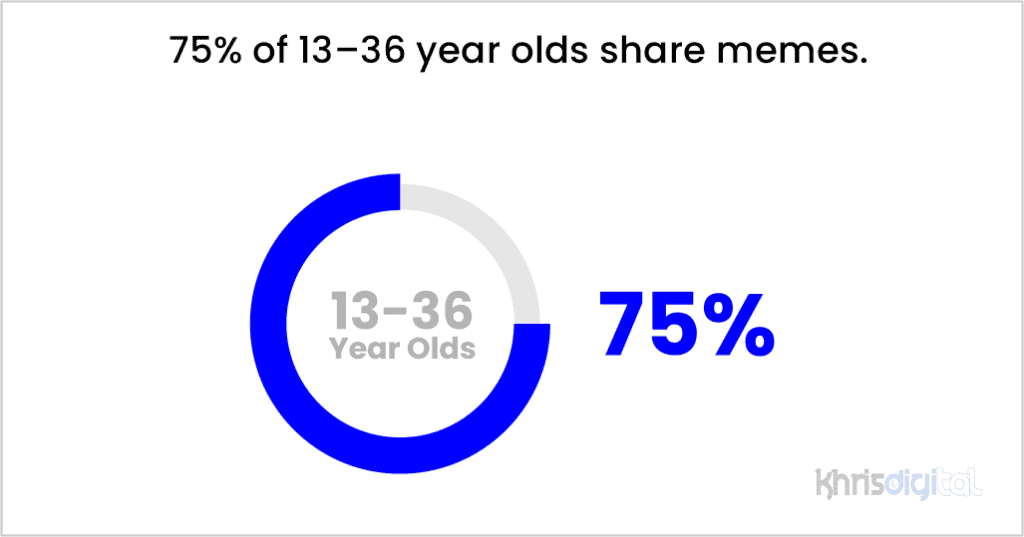
Memes are second nature to Gen Z and millennials. Three out of four in this age range actively share them, using humor to communicate, react, and connect.
For brands targeting this group, memes are the norm. This audience prefers fast, funny, and relatable content over polished perfection. If a brand can create memes that hit the right note, it’s more likely to be shared, remembered, and even loved.
25. Among the 13–36 age group, 55% send memes weekly and 30% send them daily.
(YPulse)
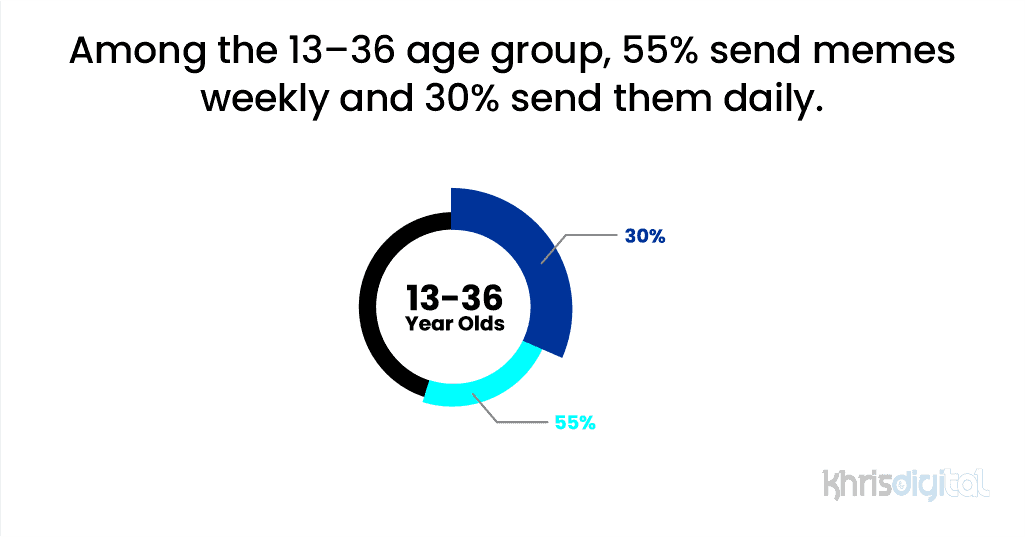
For marketers, this regular engagement means more touchpoints and more chances to connect.
Memes are part of an ongoing conversation. Tapping into that rhythm allows brands to stay top-of-mind without feeling forced. The more often people share, the more likely your content is to get pulled into their flow.
26. 79% of 13–17 year olds share memes.
(YPulse)
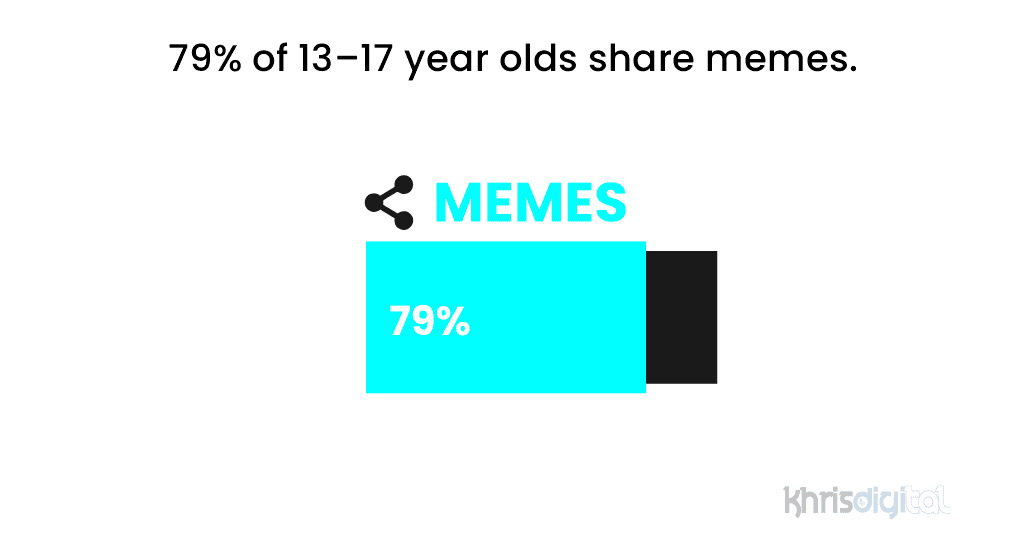
Teenagers practically live in meme culture. Nearly 8 in 10 are actively sharing memes, using them to express identity, humor, and emotion. It’s how they connect with peers and comment on the world around them.
27. Approximately 60% of viral tweets on X are meme-based.
(ElectroIQ)
On X (formerly Twitter), memes dominate virality. The platform’s speed and snappy nature make it the perfect breeding ground for meme culture. Users scroll fast and react even faster.
28. Around 70% of TikTok users actively engage with meme-style content.
(ElectroIQ)
TikTok runs on trends, and meme-style content fuels most of them. Meme content on TikTok spreads fast because it feels like play, not marketing. For brands, the message is clear: if you want attention on TikTok, think in meme language.
29. Click-through rates (CTR) for meme marketing campaigns are 14% higher than those for email marketing.
(Enterprise Apps Today)

While emails can feel transactional or routine, memes come across as spontaneous and fun. That difference in tone leads to more curiosity and interaction.
People engage with what feels native to their feed, not what lands in their inbox. For marketers looking to boost conversions without increasing pressure, meme content offers a more natural way to drive traffic and interest.
30. Meme marketing campaigns have a 19% click-through rate (CTR), higher than 6% for other marketing efforts.
(Marketing LTB)
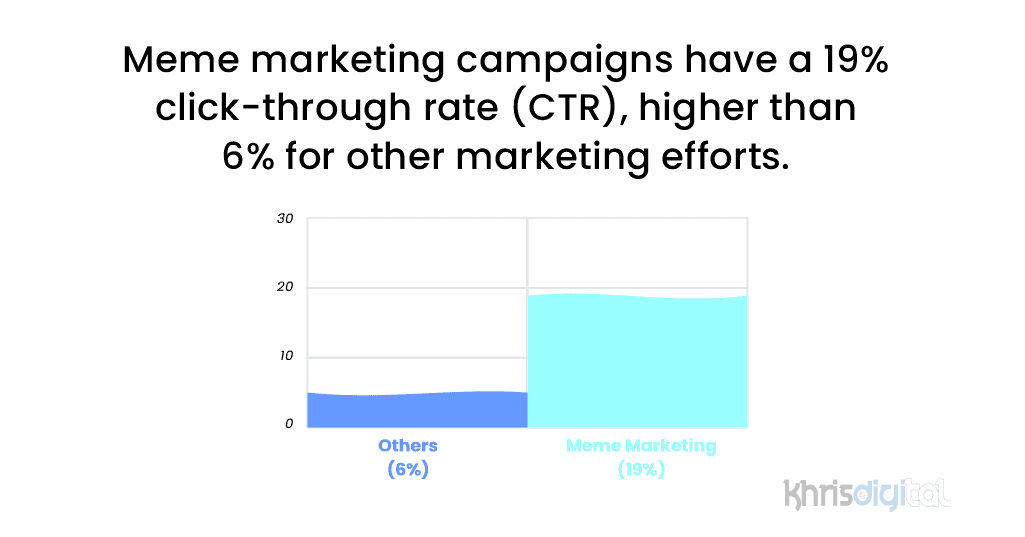
That kind of CTR gap is a wake-up call. Meme marketing pulls in clicks at more than triple the rate of standard campaigns. The reason is that memes don’t feel like marketing. They feel like content people want to engage with.
This makes the transition from scroll to click seamless. When a post entertains first and sells second, the audience is far more likely to act.
31. 31% of users share memes through private messaging.
(BrandWell)
This kind of sharing is more intimate and intentional than posting publicly. It means the content hit a nerve or nailed a feeling worth passing on.
A meme shared privately is still building relationships, driving relevance, and deepening audience engagement, even if the impact isn’t always visible.
32. An average millennial views twenty to thirty memes daily on social media platforms.
(Forbes)
Scrolling through 20 to 30 memes a day has become routine, almost like checking the weather or reading the news. This frequency shows just how embedded memes are in everyday life. They inform moods, reflect culture, and influence opinions, all in seconds.
33. 64% of young users report that memes amuse them daily.
(YPulse)
For young audiences, memes are a daily dose of joy. When nearly two-thirds say they get amused by memes every day, it shows the emotional power these simple visuals carry.
34. Among young adults aged 18–24, 71% use Instagram for memes, and 65% use Snapchat.
(BrandWell)
That says a lot about where humor lives online. These platforms make it easy to share, react, and stay up to date with trends in real time.
For marketers, knowing where meme consumption happens is half the game. Focus content where the audience already expects to laugh, and you’ve got their attention before they even scroll.
35. In the US, 57% of males and 50% of females use memes.
(ElectroIQ)
Memes are a shared language, but how they’re used can vary by gender. In the U.S., slightly more men engage with memes than women, but both groups are clearly active participants.
Over half of males and half of females regularly use memes, proving that meme culture isn’t skewed to one side. It’s a universal form of communication that crosses gender lines through humor, emotion, and shared experience.
36. In the U.S., 63% of internet users aged 18–29 have shared memes.
(Enterprise Apps Today)
With 63% of U.S. internet users aged 18 to 29 sharing memes, it’s clear this age group treats them as a natural form of digital expression. Whether it’s to react, connect, or entertain, memes have become a go-to tool for communication.
37. 33% of people in the United States check out memes daily.
(eMarketer)
For a third of Americans, memes are part of the daily scroll. Whether during a lunch break, morning commute, or late-night wind-down, memes slot naturally into everyday routines.
This daily habit reflects how deeply memes have embedded into digital culture. People turn to them for quick laughs, relatable moments, and a break from the noise.
38. 38% of internet users subscribe to meme accounts.
(Content Detector AI)
These accounts have become go-to sources for humor, commentary, and even news. For brands, this is a signal to collaborate, not just create.
Partnering with popular meme pages or building a brand-owned account can tap directly into this built-in audience and drive consistent engagement.
39. Memes are a favorite among Generation Z, with 77% using them to communicate.
(Enterprise Apps Today)
With 77% using memes as a form of communication, this generation has turned humor and visual language into everyday dialogue. It’s quick, expressive, and often more relatable than plain text.
40. 75% of individuals aged 13 to 36 post memes, 55% send memes weekly, and 30% send them daily.
(The Next Scoop)
Memes are part of the daily rhythm for younger audiences. Three out of four are actively posting them, more than half are sending them weekly, and nearly a third do it every single day.
Memes have become a preferred way to communicate, react, and stay socially connected.
41. In the US, 35% of Gen Z and Millennial internet users were likelier to post memes made by someone else.
(Forms.app)
For younger users, sharing is more common than creating. When a meme perfectly captures a feeling or thought, it gets reposted because it speaks for them.
For brands, this means meme success often hinges on how “reshareable” content is. Make it funny, timely, and emotionally on point, and your audience will do the spreading for you.
42. 18% of Gen Z respondents believe brands should be funny in their created content to connect with their sense of humor.
(GWI)
Gen Z expects brands to entertain, not just inform. Nearly one in five say humor is the key to making that connection.
Dry or overly polished content gets ignored. Funny content, especially when it feels authentic, earns attention and trust. For marketers, this is permission to be playful.
43. 43% of 13 to 17 year olds and 56% of 18 to 20 year olds follow meme accounts.
(Forms.app)
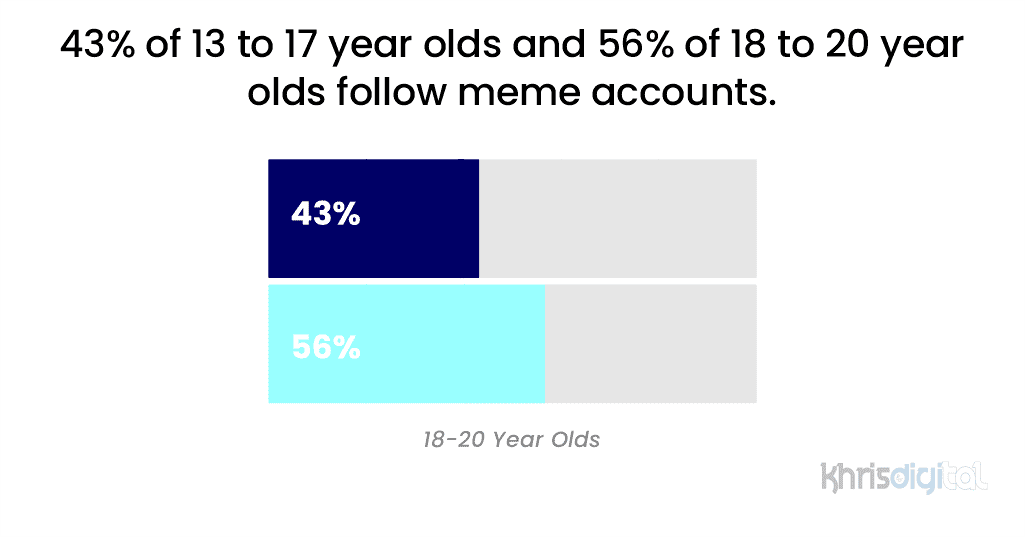
Nearly half of teens and over half of early twenty-somethings actively follow meme accounts to keep up with trends, jokes, and cultural moments.
These accounts are daily sources of expression and identity. For brands, this is a chance to show up where younger audiences are already paying attention. Partnering with or creating meme-driven pages can build trust faster than any traditional campaign.
44. In the U.S., 64% of 18–29-year-olds said they use memes, compared to lower percentages in older groups.
(Marketing LTB)
Younger adults lead the meme movement. Usage drops in older groups, showing that meme culture is still largely youth-driven. This age range grew up online, so humor, commentary, and expression through memes feel second nature.
45. Among 30–49 year-olds, meme usage is lower; among 65+, much lower.
(Marketing LTB)
As age increases, meme use drops. While younger users treat memes as daily language, older adults engage with them less frequently. The 30–49 crowd still sees memes but may not share or create as often. For the 65+ group, usage is minimal.
This split matters for brands, especially those targeting broader age ranges. What lands with Gen Z might confuse or be missed by older audiences.
46. Meme formats differ by gender as males tend to engage more with “funny memes,” females more with “cute” or “reaction” memes.
(Persuasion Nation)
Not all memes hit the same way. Engagement patterns show that men are more drawn to classic humor formats such as punchlines, absurdity, and satire. Women, on the other hand, are more likely to interact with reaction memes and content that leans into emotional or “cute” territory.
This isn’t about stereotypes. Both groups enjoy memes, but the content that resonates differs.
47. Women are more likely than men to use Instagram and Pinterest for memes (33% vs 25%).
(Marketing LTB)
Where people find their memes often depends on who they are. Women are more likely than men to turn to visually-driven platforms like Instagram and Pinterest for meme content.
These spaces are built for aesthetics, reactions, and fast sharing — all things that align with the way many women engage online. For marketers, this means meme distribution is about the content, not just about picking the right channels.
48. Political memes make up about 60% of all memes.
(Forbes)
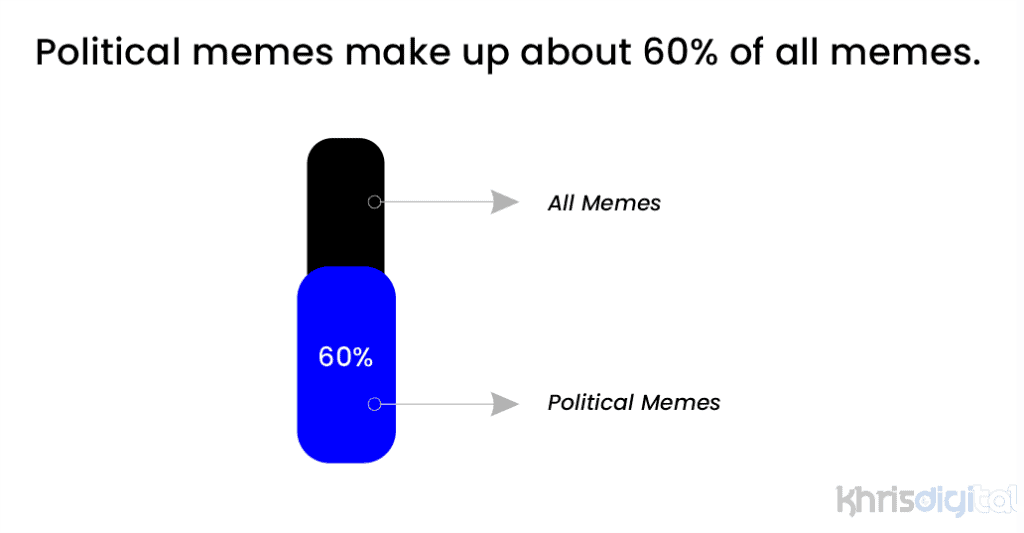
Politics and memes go hand in hand. Around 60% of all online memes have political undertones or themes, showing how often people use humor to process complex issues.
Memes simplify debates, express opinions, and let users vent or rally without saying a word.
While political memes dominate in volume, stepping into that arena requires extreme awareness, because in meme culture, one misstep can become the meme.
49. Fifty-four percent of respondents share more political memes than before the pandemic.
(eMarketer)
With stress high and trust in traditional media low, memes became a coping tool and a shortcut for communication. They let people voice frustration, solidarity, or satire without a full post or debate.
50. In Brazil and Mexico, 86% and 85% respectively, had shared memes in the past month.
(Marketing LTB)
Meme culture is deeply rooted in everyday life across different countries. In Brazil and Mexico, over 85% of internet users had shared a meme in just one month.
That level of activity shows how memes function as a universal language, cutting across borders and instantly translating humor, emotion, and opinion.
51. In China, among ages 20–29, ~63% use memes; among 30–39, ~40% use memes.
(Marketing LTB)
Even in tightly regulated digital spaces like China, meme culture thrives, especially among younger users.
About 63% of people aged 20 to 29 engage with memes, compared to around 40% in the 30 to 39 bracket. That drop-off highlights how meme use skews younger, mirroring global trends.
For brands targeting Chinese audiences, memes offer a relatable, culturally flexible format. But success depends on understanding local humor, symbols, and digital norms, because context drives connection.
52. In North America, memes are especially popular in the 18–29 cohort.
(Marketing LTB)
Young adults in North America are driving meme culture hard. The 18–29 age group leads in both consumption and sharing, treating memes as a primary way to communicate, react, and stay plugged into digital life.
From trending formats to niche humor, this group moves fast and sets the tone for what catches on.
53. In the UK, ~51% of respondents said they use memes; in France ~47%; in Germany ~42%.
(Marketing LTB)
These numbers show that while meme culture is global, engagement levels shift by region. Cultural context, humor styles, and platform preferences all play a role.
For brands operating across borders, this highlights the need for localized meme strategies. What lands in London might need tweaking for Paris or Berlin, but the format still opens doors across all three.
54. The average meme lifespan is 4.017 months.
(The EyeOpener)
Memes may feel fast and fleeting, but the average one lasts just over 4 months. That’s longer than most trends in digital culture.
While some memes burn out in days, the strongest ones evolve, get remixed, and stay relevant across platforms. This gives marketers a valuable window that is long enough to build campaigns, but short enough to demand agility.
Memes live in cycles, and brands that know when to jump in and when to move on, stay ahead of the scroll.
55. In a web-scale analysis, memes originating from the top 10% of communities by network centrality generate ~62% of diffusion events.
(ACM Digital Library)
Not all meme sources are equal. A small, highly connected group of online communities (the top 10% by network centrality) is responsible for nearly two-thirds of all meme spread.
These digital hubs act as launchpads, pushing content into wider circulation at scale. For marketers, this means targeting the right communities matters more than trying to reach everyone at once.
Influence starts with the few who are most connected, and if a meme catches fire there, it moves fast and far.
56. Memes with origins in more central communities tend to diffuse more widely, even accounting for size and activity.
(ACM Digital Library)
Memes born in central online spaces spread further, even when those spaces aren’t the largest or busiest. Centrality means access to more bridges, influencers, and cross-community pathways. That structure gives content a better shot at going viral.
57. A study of 3 million+ memes found that “core” communities, not just peripheries, tend to seed viral memes.
(ACM Digital Library)
Virality doesn’t start at the edges; it often begins at the center. A large-scale study tracking over 3 million memes revealed that core communities, those deeply embedded in the digital network, are more likely to kick off viral trends.
While peripheral groups can help spread memes, it’s the central hubs with stronger connections and influence that act as consistent launchpads.
58. Memes sometimes behave like a “metalanguage,” evolving structural conventions that users implicitly understand.
(Marketing LTB)
Memes are a form of coded communication. Over time, they develop their own visual grammar, formats, and rhythms that regular users instantly recognize.
This makes them function like a metalanguage, which is a layer of meaning built on shared context and unspoken rules.
A certain font, image placement, or phrasing can carry more meaning than a full caption. For brands, understanding this structure is critical. Miss the format, and the message falls flat. Get it right, and you speak the internet’s native language.
59. Memes also accumulate “mutations” (i.e., remixes, adaptations, variants) as they circulate.
(Marketing LTB)
Memes evolve with every share. As they move through different corners of the internet, users remix them, add context, or tweak formats to reflect new ideas. These “mutations” are what keep memes alive and culturally relevant.
60. Internet meme diffusion exhibits “rich-get-richer” dynamics: popular memes gain more exposure, making them more likely to be shared further.
(Marketing LTB)
Once a meme picks up momentum, it enters a feedback loop: more views lead to more shares, which lead to even more visibility. This “rich-get-richer” dynamic means early traction can turn a meme into a movement.
For marketers, this highlights the importance of timing and platform placement. If a meme catches fire early in the right space, its chances of breaking through increase exponentially.
61. Some research uses meme engagement patterns to infer personality traits or individual determinants.
(Marketing LTB)
Meme behavior can reveal who someone is. Researchers have started analyzing which memes people engage with to draw insights about personality, mood, and even psychological traits.
Whether it’s a preference for sarcasm, dark humor, or wholesome content, patterns in meme sharing can hint at deeper emotional and cognitive tendencies.
62. Memes have been studied in machine learning contexts for sentiment, affect, and multimodal understanding.
(Marketing LTB)
Researchers in machine learning have begun using memes to train systems to recognize sentiment, detect emotion, and process multimodal content (text and images).
Unlike plain text, memes combine visual cues with context-driven language, making them ideal for testing how machines interpret human expression. This research is helping AI systems better understand humor, sarcasm, and social nuance.
Final Thoughts on Meme Marketing Statistics
Meme marketing is a shift in how people connect, communicate, and engage with brands.
These meme marketing statistics prove that memes go far beyond surface-level entertainment. They spark emotions, build relationships, influence buying behavior, and shape culture in real time.
Whether it’s Gen Z using memes as a native language or marketers seeing real ROI from meme-driven campaigns, if you’re not using memes, you’re missing out on where the conversation is actually happening.
The best part is that you don’t need a massive budget or a full creative team. You just need to understand the tone, the timing, and the culture.
Get those right, and your content will be seen, shared, remembered, and maybe even memed back.
Sources:
Check out my other Statistics round up:
