

You’re already falling behind if you’re not using visual content in your marketing. Articles with images get 94% more views, and videos can increase conversion rates by up to 80%.
This is proof that visuals have become essential.
With the global visual content market projected to hit $19.17 billion by 2032, the demand for eye-catching, engaging media is only growing.
In this article on visual content statistics, I’ll dive into the numbers that show why visuals are the key to better engagement, stronger branding, and higher conversions.
1. The global visual content market is expected to reach $19.17 billion by 2032, at a CAGR of 15.6%.
(Business Research Insights)

Several factors contribute to this increase. Businesses are recognizing the impact of visual content on consumer engagement and brand awareness.
As digital platforms evolve, the ability to convey messages effectively through images, videos, and graphics becomes more critical. Companies are investing more in visual content strategies, knowing that compelling visuals can significantly influence purchasing decisions.
2. Over 50% of marketers use visuals in over 91% of their content.
(Venngage)
Effective use of visuals can increase engagement and improve information retention. Marketers recognize that 91% of consumers prefer visuals to text, prompting them to adapt their strategies.
Integrating original graphics, videos, and infographics enhances your content’s appeal and effectiveness. Consumers are more likely to fully engage with content that includes eye-catching visuals, leading to better conversion rates and audience connection.
3. According to a survey by Venngage, original graphics are the most used type of visual content by marketers at 36%, followed by stock photos at nearly 34%.
(Venngage)
Marketers’ preference for original graphics highlights the importance of unique, tailored visuals in content strategy. At 36%, this statistic shows that you will likely engage your audience more effectively with original designs, such as infographics and illustrations that resonate with your brand identity.
In contrast, stock photos, utilized by nearly 34% of marketers, offer convenience but often lack the personal touch.
Relying on a more generic visual can dilute your message. By prioritizing original graphics, you strengthen your brand and enhance connection with your audience, making your content stand out in a crowded marketplace.
4. 30% of marketers primarily create visual content for blogs, followed by social channels such as Facebook and LinkedIn.
(Venngage)
This choice shows the importance of engaging readers through eye-catching visuals. Blogs incorporating images, infographics, and videos tend to attract more visitors and keep them on the page longer.
In addition to blogs, social media platforms like Facebook and LinkedIn play a crucial role in visual content strategies. Because of these platforms’ visual nature, marketers can effectively reach their target audience.
Using images or short videos on social media enhances brand visibility and encourages sharing, which can significantly amplify your message.
5. Over 50% of marketers agree that visual content is essential to their marketing strategy.
(Venngage)
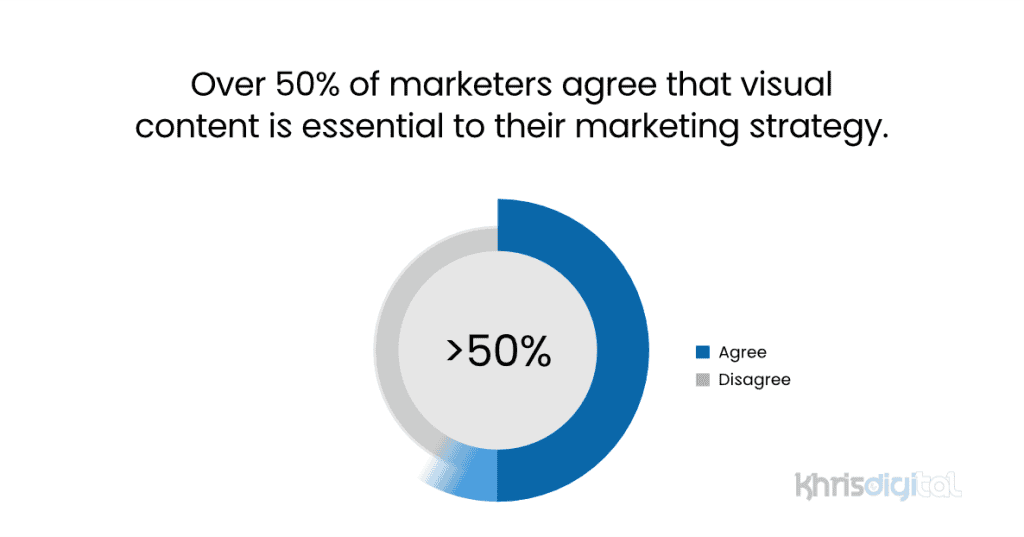
In today’s fast-paced digital landscape, the importance of visual content cannot be understated. More than half of marketers recognize that utilizing visuals is crucial for engaging their audience effectively.
Statistics show that 65% of people are visual learners, so incorporating images, infographics, and videos can enhance communication and retention.
When crafting your marketing strategy, consider how visuals influence your messaging. Engaging visuals attract attention and help convey complex information clearly and quickly.
6. 43% of content marketers say original graphics are the best-performing type of visual content. The following top response was stock photos (34%), followed by videos and presentations (33%), charts and data visualizations (31%), multi-page documents (25%), and GIFs and memes (11%).
(Venngage)

Regarding visual content, original graphics stand out as the top performers, with 43% of content marketers highlighting their effectiveness. Originality often captures attention and promotes brand identity better than generic images.
In second place, stock photos account for 34%, demonstrating a solid preference among marketers. Following closely are videos and presentations at 33%—these formats combine visuals with dynamic elements.
Other types, such as charts and data visualizations (31%), multi-page documents (25%), and GIFs and memes (11%), also contribute to a diverse content strategy. Still, their performance is noticeably less impactful compared to original graphics.
7. Regarding content creation, 30% of marketers share infographics.
(HubSpot)
This choice reflects a growing understanding of how visual storytelling can simplify complex information. By presenting data in a visually appealing format, infographics can engage audiences more effectively than traditional text.
Using infographics can also enhance your content’s shareability. They often lead to higher engagement rates on social media platforms. This popularity stems from their ability to convey key messages quickly, making them ideal for audiences that skim through content.
8. People following directions with text and illustrations do 323% better than people following directions without illustrations.
(Springer)
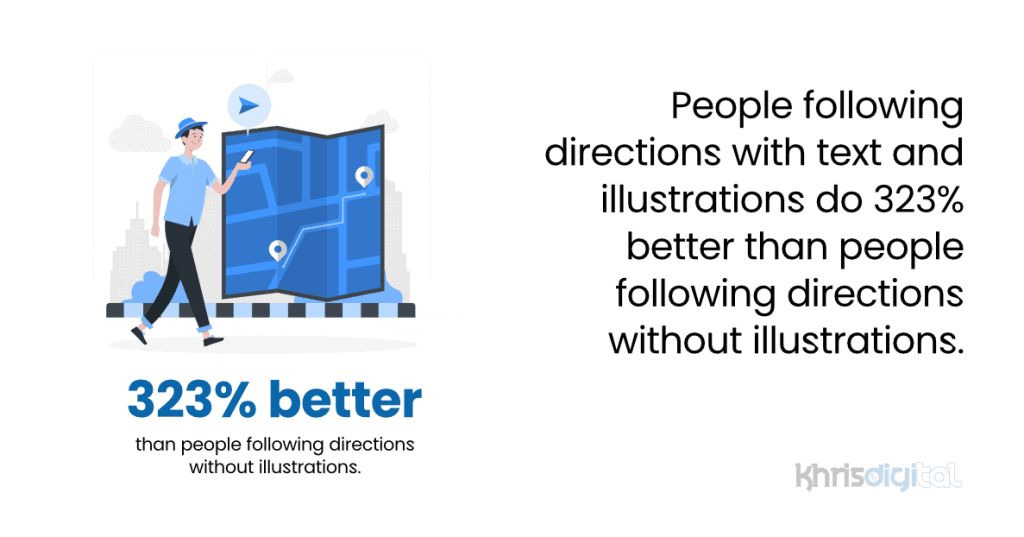
Visual content plays a significant role in how effectively you grasp information.
Instructions that include illustrative elements become more engaging and easier to follow. Visuals break down complex information and highlight key points. They serve as a guide, making the material more accessible.
Integrating images and diagrams significantly enhances understanding and task execution in manuals, online tutorials, and educational content.
9. The human brain processes visual content 60,000 times faster than text.
(LMC)
The human brain is remarkably efficient at processing visual information. This rapid processing highlights the importance of visuals in communication, particularly in an age when attention spans are shorter than ever.
When you encounter visual content, such as images or infographics, your brain quickly decodes the information without requiring extensive cognitive effort. Around 90% of the information transmitted to your brain is visual.
Incorporating visuals into your content can enhance engagement and retention, making them a powerful tool for delivering messages effectively.
10. Visual content gets 94% more views than text content.
(Outbrain)
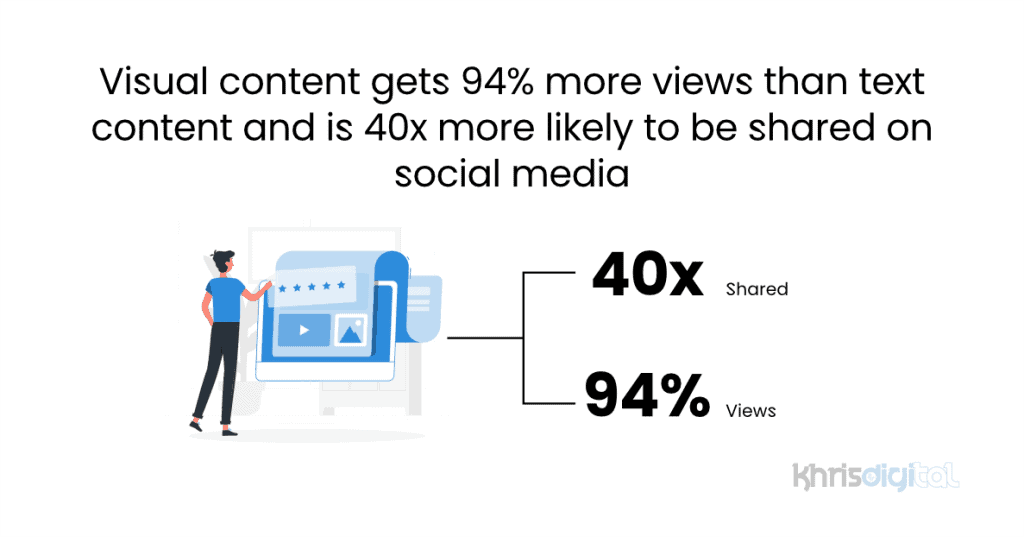
This statistic highlights the importance of integrating images and graphics into your content, as they attract more attention and encourage sharing.
With the rise of social media, including visuals in your posts can make a substantial difference. Visuals capture interest and help convey your message more effectively, leading to higher engagement and interaction rates with your audience.
11. Visual content is 40x more likely to be shared on social media.
(Reusser)
Utilizing visuals can create instant engagement. People are naturally drawn to eye-catching images and videos, which can convey messages more effectively than words alone.
Consider incorporating infographics or short clips to maximize shares and interactions in your social media strategy. This approach captures attention and encourages audience participation through shares and comments.
12. Infographics can increase web traffic by up to 12%.
(Rock Content)

Presenting complex information visually makes it easier for your audience to understand and remember your content. When using infographics, you tap into a quick and effective communication method.
They encourage sharing on social media, which can drive even more traffic to your site. To maximize their effectiveness, consider creating themed infographics that align with your marketing goals.
13. Infographics are liked and shared 3x more on social media than other types of content.
(SMA Marketing)
Infographics stand out in visual content, attracting significant attention on social media. Their appeal lies in their ability to present complex information in a visually appealing and easily digestible format.
Creating compelling visuals makes your audience more likely to engage with and share your content. Incorporating infographics into your social media strategy can help amplify your message and connect with your followers more effectively.
14. You get 2.3 times more engagement on Facebook when you use visual content.
(BuzzSumo)
Additionally, utilizing videos can further increase engagement. For example, tweets with videos receive about 10 times more interactions than text-only tweets.
By prioritizing visual elements, you can effectively capture your audience’s attention and drive more significant interaction with your content. Engaging visuals draw people in and encourage them to share your posts with their networks, amplifying your reach.
15. 91% of consumers say they want to see brands share more online videos.
(HubSpot)
Engaging your audience through video is more crucial than ever. Video captures attention and also enhances understanding and retention of information.
Incorporating more video content into your marketing strategy can increase engagement, conversion rates, and educational value.
16. 50% of marketers now use video in their content marketing strategy.
(HubSpot)
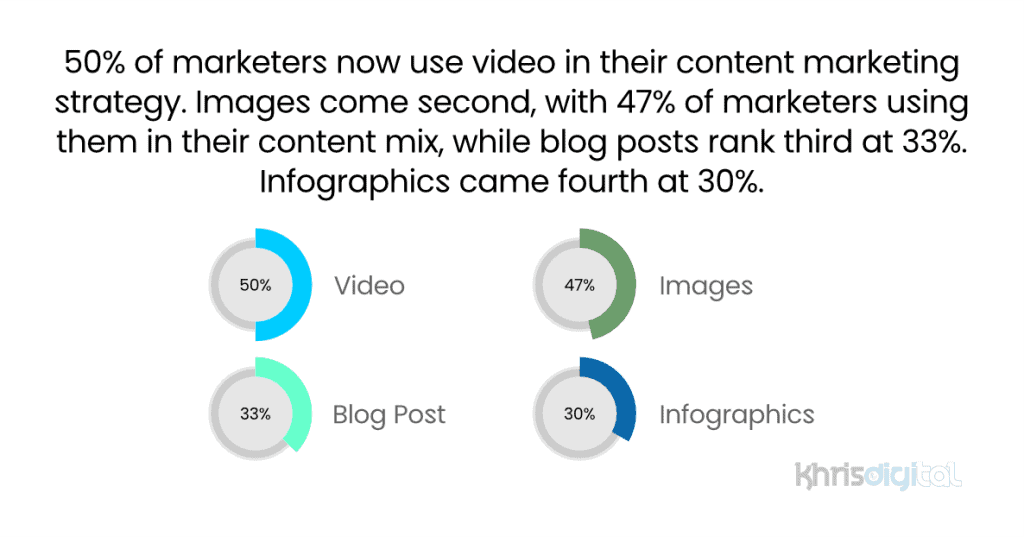
This shift showcases a growing recognition of video’s impact on audience engagement. Video is not just about telling your brand’s story; it helps create a connection that static images and text often miss.
With 95% of marketers believing video is crucial to their strategy, the trend indicates that you should consider incorporating video into your content marketing efforts to remain competitive.
17. Images come second, with 47% of marketers using them in their content mix, while blog posts rank third at 33%. Infographics came fourth at 30%.
(HubSpot)
Images play a critical role in today’s marketing landscape. With 47% of marketers incorporating them into their content strategies, they effectively capture audience attention. The visual appeal of images can enhance engagement and retention.
Following images, blog posts have a 33% usage rate among marketers. While they remain essential for providing in-depth information, shorter attention spans have led to a preference for visual content.
Infographics also make an impact, ranking fourth with 30% usage. These visual tools combine data and design, simplifying complex information for your audience and making it more digestible.
18. 85% of marketers plan to expand/maintain their video budget.
(WebFX)
This commitment reflects their confidence in the effectiveness of video marketing, which has proven to enhance audience engagement. The reasons behind this trend are clear. Video content can captivate viewers, making it a powerful tool for storytelling and brand promotion.
With nearly 90% of marketers reporting a positive return on investment (ROI) from their video efforts, businesses are recognizing the value of allocating resources to this format.
19. Conversion increases 86% when videos are used on a landing page.
(Demand Gen Report)
Many users prefer to watch videos over reading text, so adapting your marketing strategies accordingly can be beneficial. You can leverage this preference by embedding relevant video content on your landing pages.
This improves the user experience and enhances your chances of converting visitors into customers. Consider presenting key information in video format, as it can convey your message succinctly while keeping the audience engaged.
20. Over 50% of marketers spend over 10 hours producing visual content. Of those, 34.3% say they spend 10 to 15 hours, and 29.9% say they spend over 20 hours on that task.
(Venngage)
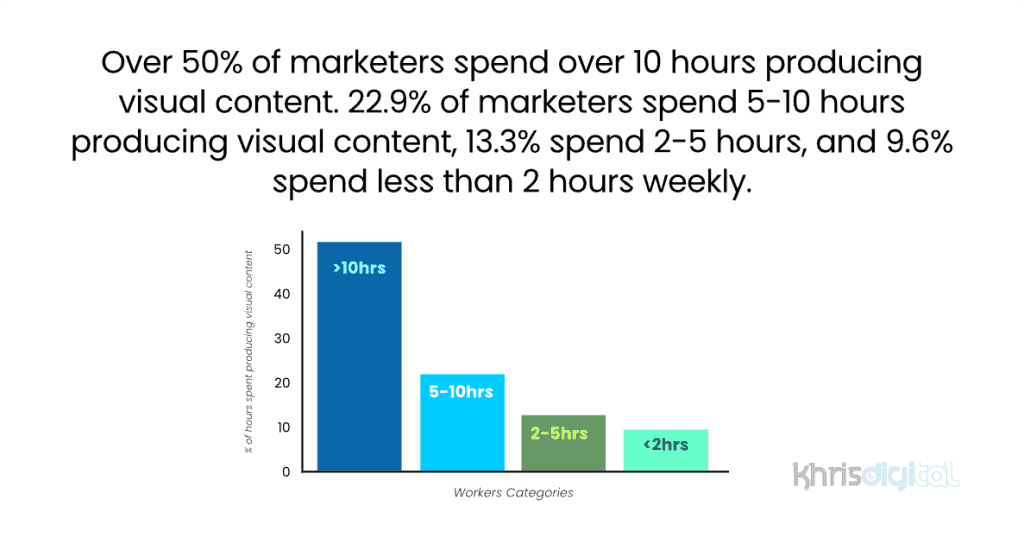
Creating engaging visual content requires significant time investment. Over 50% of marketers dedicate more than 10 hours to this essential task.
Among those who invest this time, 34.3% spend 10 to 15 hours, while 29.9% allocate over 20 hours to the process. This shows a clear trend: many of you recognize that compelling visuals can enhance audience engagement and drive better results.
By understanding the time commitment involved, you can better plan your content creation to ensure maximum impact.
21. 22.9% of marketers spend 5-10 hours producing visual content, 13.3% spend 2-5 hours, and 9.6% spend less than 2 hours weekly.
(Venngage)
According to recent statistics, 22.9% of marketers dedicate 5 to 10 hours per week to this task, showcasing a significant commitment to creating engaging visuals that capture audience attention.
In addition, 13.3% of marketers spend 2 to 5 hours weekly on visual content production, while 9.6% allocate less than 2 hours.
These varying time investments suggest that while some prioritize visual engagement heavily, others may still recognize its importance without delving deeply into production. This information can guide your content creation strategies, helping you assess where your time might be best spent.
22. 32.4% of marketers spend over 50% of their budget on visual content, and 22.9% said they spend around 20-50% on visual content.
(Venngage)
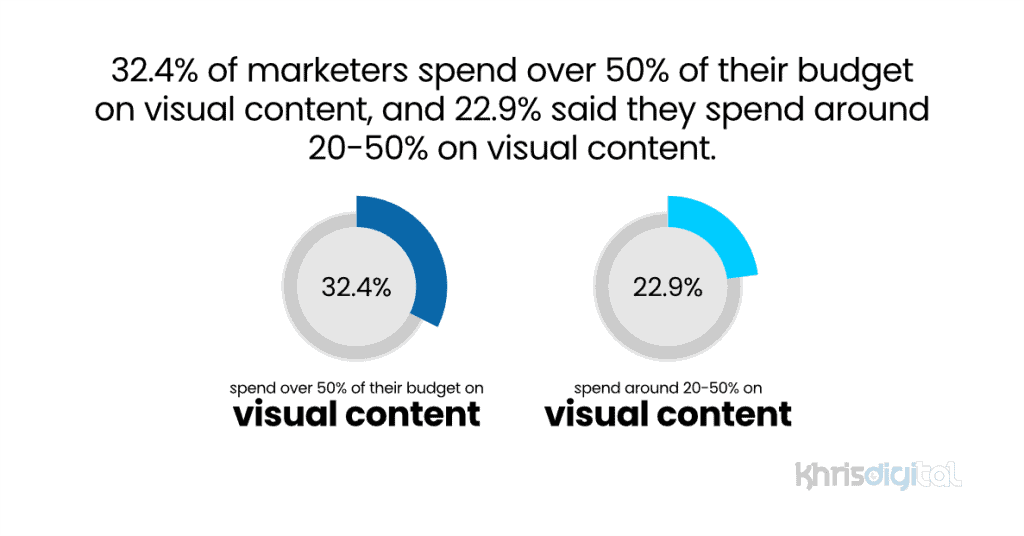
According to recent statistics, 32.4% of marketers dedicate more than 50% of their overall budget to visual assets. This level of commitment highlights the critical role that images, videos, and graphics play in effective marketing strategies today.
Additionally, 22.9% of marketers report spending between 20% and 50% of their budgets on visual content.
This suggests that many recognize the value of visual elements in their campaigns, driving engagement and conversions. With the rise of social media and digital platforms, relying on compelling visuals has become essential for standing out in a crowded marketplace.
23. 80% of marketers use images in all their posts on social media.
(Blogging Wizard)
This shift indicates a clear preference for content that captures attention quickly. Images stand out and enhance engagement as users scroll through feeds filled with text.
Utilizing images can boost effectiveness significantly. Posts that include visuals receive 150% more engagement compared to text-only posts. By incorporating eye-catching graphics, you can increase your audience’s interaction, whether likes, shares, or comments.
24. 47.6% of surveyed marketers said YouTube is the top distribution platform for visual content. 39.1% pointed to Instagram, 35.2% said LinkedIn, 31.4% Facebook, and 26.7% TikTok.
(Venngage)

When considering where to distribute visual content, YouTube stands out, with 47.6% of surveyed marketers identifying it as their top choice.
This platform’s extensive reach and video-centric nature make it ideal for engaging audiences effectively. You can leverage this by creating compelling video content that aligns with your brand strategy.
Following YouTube, Instagram comes in strong at 39.1%. Known for its visual appeal, Instagram is perfect for eye-catching images and stories.
Additionally, platforms like LinkedIn (35.2%), Facebook (31.4%), and TikTok (26.7%) offer unique opportunities for marketers to connect through various types of visual content. Each platform serves a different audience, so understanding your target demographic is key.
26. 24.8% of marketers said they posted visual content to their blogs, 23.8% shared it on their landing pages, and 17.1% used it in their print/branding materials.
(Venngage)
Visual content plays a significant role in communicating with your audience. 24.8% of marketers utilize visual content on their blogs, demonstrating a clear trend towards engaging readers.
This approach enhances the aesthetic appeal and helps convey complex information in a more digestible format.
Moreover, 23.8% of marketers incorporate visual content on landing pages. These pages benefit from elements like images and graphics that provide cues for call-to-action buttons.
Meanwhile, 17.1% use visuals in print and branding materials, highlighting the versatility of visual content across various platforms. This strategic use of visuals emphasizes your brand’s message and improves overall engagement.
26. 79% of marketers report posting their video content to YouTube.
(Content Marketing Institute)
This trend highlights a clear shift in how brands approach audience engagement. YouTube’s vast reach and user-friendly features make it an attractive choice for marketers aiming to connect effectively with potential customers.
The platform’s benefits are significant. With more than 500 hours of video uploaded every minute, it offers opportunities to reach diverse audiences.
Whether you’re sharing how-to videos, product demonstrations, or branded stories, YouTube supports various formats that appeal to your target demographic.
27. After YouTube, LinkedIn is the next most popular place for marketers to post video content (76%), followed by Facebook (72%), Instagram (71%), X (38%), and TikTok (28%).
(Content Marketing Institute)
After YouTube, LinkedIn is a strong contender, with 76% of marketers utilizing it. This platform is particularly valuable for B2B strategies, allowing professionals to connect and engage with a focused audience.
Facebook and Instagram closely follow at 72% and 71% respectively. These platforms cater to a diverse audience and provide excellent visibility tools.
X (formerly Twitter) holds 38%, leveraging its real-time engagement potential, while TikTok, at 28%, caters to a younger demographic with short, engaging videos. Knowing where your audience spends their time can significantly enhance video marketing efforts.
28. 41.9% of brands publish visual content 5-10 times per week, 36.2% of brands publish visual content 2-5 times weekly, 13.3% of brands publish visual content less than twice a week, and 8.6% of brands publish visual content more than 10 times per week.
(Venngage)

The frequency with which brands publish visual content reveals a strong commitment to engaging their audiences. Specifically, 41.9% of brands generate visual content 5-10 times weekly.
This high volume of visual output indicates a strategy focused on maintaining visibility and fostering connection through diverse and compelling imagery.
Additionally, 36.2% of marketers post visual content 2-5 times weekly, while 13.3% publish it less than twice a week.
A smaller segment, 8.6%, exceeds ten posts weekly. This distribution emphasizes the importance of consistent content creation for brand presence in a visually driven market.
29. Around 14 billion images are shared on social media every day.
(Edge Delta)
This staggering number highlights the dominant role that visual content plays in digital communication. Social media users increasingly prefer images over text, making visuals essential for engaging audiences effectively.
For businesses, creating eye-catching content can improve interaction rates and enhance brand visibility on these platforms.
30. WhatsApp is the top social media platform by images shared daily.
(Edge Delta)
WhatsApp has become a powerhouse for sharing visual content. This trend shows the effectiveness of instant messaging apps in facilitating quick photo exchanges among friends, families, and groups.
WhatsApp’s ease of sharing images encourages users to engage more frequently. You can send pictures directly in a conversation without leaving the app, making it convenient for sharing memories and moments.
31. Users on WhatsApp share 6.9 billion photos every day. That’s almost 2x more than the second top platform to share images, Snapchat, at 3.8 billion. Facebook ranks third at 2.1 billion, and Instagram ranks fourth at 1.3 billion.
(Edge Delta)
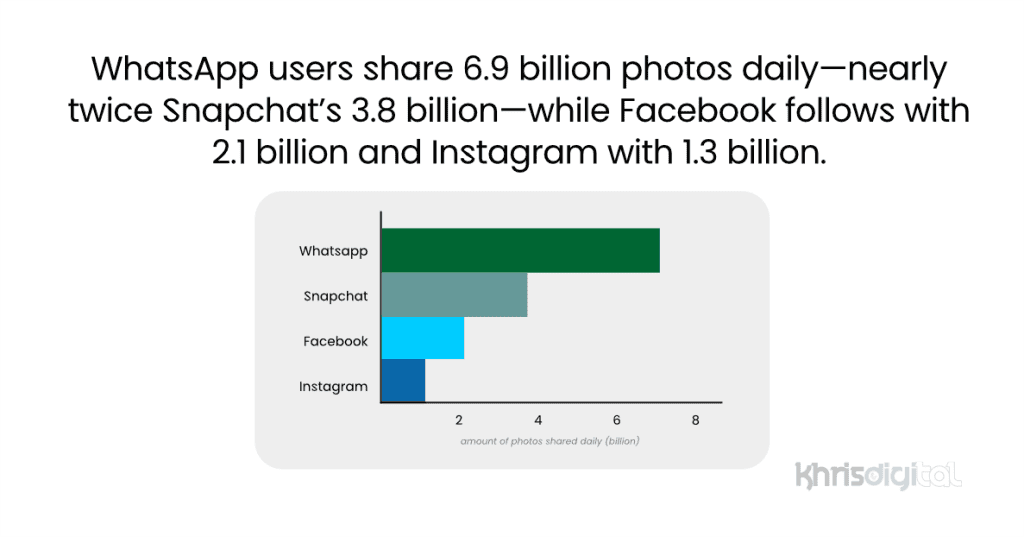
WhatsApp is a dominant player in the visual content landscape, with users sharing 6.9 billion photos daily. This staggering number illustrates the platform’s extensive reach and user engagement.
In comparison, Snapchat comes in second place, with 3.8 billion photos, showcasing WhatsApp’s significant lead in the photo-sharing space.
Following WhatsApp and Snapchat, Facebook and Instagram contribute to the visual content ecosystem. Facebook users share around 2.1 billion photos daily, while Instagram accounts for approximately 1.3 billion.
These figures highlight the competitive nature of social media platforms, but WhatsApp’s remarkable statistics emphasize its unique position as a preferred medium for sharing images.
32. 49.5% of brands now use the WEBP format for their images. JPEG is the second most popular image format, at 19.9%, while AVIF ranks third at 13.3%. HEIC and PNG are joint fourth at 8.7% each.
(Cloudinary)
As a digital creator or marketer, you may have noticed the rise of various image formats in your work.
Currently, 49.5% of brands utilize the WEBP format, which is known for delivering high-quality images at reduced file sizes. This efficiency helps improve website performance, loading times, and overall user experience.
Following WEBP, the JPEG format maintains significant popularity, with 19.9% of brands still opting for it. At 13.3%, AVIF presents a strong alternative, particularly for those focused on modern web applications.
Interestingly, HEIC and PNG share a place in the rankings at 8.7% each, indicating that while newer formats emerge, traditional formats still hold their ground in various applications.
33. 51.4% of marketers use advanced design software to create visual content.
(Venngage)
This emphasis on quality demonstrates the importance of visuals in capturing audience attention. By utilizing such software, you enhance not just aesthetics but also storytelling within your marketing strategies.
Original graphics can reinforce your brand identity and improve user engagement. As visual content continues to dominate, investing in advanced design tools becomes a strategic necessity for effective marketing.
34. 50.5% of marketers let their in-house designer create their visuals, 40% use online tools or graphic makers (like Canva or Venngage), and 24.8% outsource the job to a freelance designer.
(Venngage)

50.5% of marketers rely on their in-house designers to produce visuals. This choice allows you to maintain brand consistency and leverage internal knowledge. In-house teams can effectively tailor visuals to align with marketing goals and the company’s identity.
For those who prefer a more hands-on approach or lack design resources, 40% of marketers turn to online tools like Canva or Venngage. These platforms empower you to create high-quality graphics without needing extensive design skills.
On the other hand, 24.8% opt for outsourcing to freelance designers. This option can provide access to specialized skills and fresh perspectives, making it suitable for unique projects or campaigns.
35. 77% of organizations use social media videos in their marketing campaigns, making this the most popular type of video.
(Content Marketing Institute)
In today’s digital landscape, social media videos have firmly established themselves as the most commonly used type of video content among organizations.
Short, dynamic videos on platforms like Facebook, Instagram, and TikTok can capture attention quickly and showcase products or services in a way that resonates with viewers.
Videos can convey your brand’s message succinctly and creatively. Whether they’re a quick tutorial, a behind-the-scenes look, or user-generated content, these videos foster connection and encourage sharing.
36. 61% said they use branded stories (i.e., short films and documentaries), 59% said they use how-to or explainer videos, and 54% said they use interviews with influencers.
(Content Marketing Institute)
As you explore the visual content landscape, the data reveals that 61% of marketers leverage branded stories. Often presented as short films or documentaries, these narratives provide depth and emotional connection.
They can significantly enhance brand storytelling and resonate with audiences seeking meaningful content.
In addition to storytelling, 59% utilize how-to or explainer videos. These formats are essential for educating your audience about products or services. They simplify complex topics and help viewers make informed decisions.
Meanwhile, 54% are using interviews with influencers, which can lend credibility and authenticity to your brand message. Engaging influencers can create trust and effectively reach wider audiences.
37. 54% of marketers also said social media videos produce the best results of any marketing video. The next top-voted video type in the survey was case studies/testimonial videos (51%), followed by how-to videos/explainers (48%) and branded stories (44%).
(Content Marketing Institute)
Social media videos are increasingly recognized for their effectiveness in marketing. With 54% of marketers endorsing them as the best result-producing video type, it’s clear that these platforms are pivotal for reaching audiences.
Their shareable nature and the ability to engage viewers in real time contribute significantly to their success.
Following social media videos, case studies/testimonials come in at 51%, showcasing real customer experiences. These types of videos build trust and authenticity.
Additionally, 48% of marketers use how-to videos/explainers to provide valuable information, helping customers understand products better. Lastly, 44% of the votes go to branded stories, which allow brands to connect emotionally with their audience.
38. 17% of marketers say short-form video content is the marketing trend that’s generated the best results.
(HubSpot)
This format resonates well with audiences because it delivers quick, impactful messages. In an age with shorter attention spans, videos capturing interest within the first few seconds can significantly boost engagement.
Marketers leverage platforms like TikTok, Instagram Reels, and YouTube Shorts to engage viewers. A concise video allows you to highlight key information or showcase your brand’s personality without overwhelming your audience.
39. Long-form videos have grown by 11,000% over the past decade.
You might find it surprising that these videos, often exceeding 30 minutes, have seen an 11,000% increase in utilization over the past ten years. This surge indicates a growing appetite for in-depth, engaging content that provides substantial value.
Viewers increasingly prefer long-form videos because they can delve deeply into topics. Webinars, tutorials, and live events are examples of this format thriving in today’s digital landscape.
With 87% of businesses noting increased lead generation from video marketing, it’s clear that investing in longer video content can yield strong results for your audience engagement and brand loyalty.
40. Marketers rate the difficulty of producing visual content 7 out of 10.
(Venngage)
This rating highlights professionals’ significant obstacles, including resource allocation, skill development, and time constraints. While 43% of marketers identify creating high-quality visual content as a primary challenge, many seek practical solutions.
To alleviate some of this pressure while maintaining quality, you might find it beneficial to invest in graphic design tools, training, or even consider outsourcing.
41. 16% of marketers say their top challenge with visual content is finding ideas for new content, 16% say creating content that generates lots of engagement, and 15% say creating content that drives plenty of website traffic.
(HubSpot)
Many marketers face significant challenges with visual content. 16% report that generating fresh ideas is a primary concern. This signals a need for consistent brainstorming and strategic thinking to keep content vibrant and engaging.
Another 16% focus on crafting content that fosters high engagement. This is crucial because engaging visuals can captivate your audience and encourage interaction. Lastly, 15% highlight the challenge of creating visuals that effectively drive traffic to their websites.
42. 50.5% of marketers say they struggle to find the proper layout for their visual content.
(Venngage)
Finding the proper layout for visual content is a significant challenge for many marketers. The design is crucial as it influences how effectively a message is communicated and how engaging the content appears to the audience.
When designing visual content, it is vital to consider elements like balance, alignment, and spacing. A thoughtful layout can enhance viewer engagement and comprehension.
Marketers must experiment with various formats, including infographics, social media posts, and presentations, to discover what resonates best with their target audience.
43. 69% of marketers say the top barrier they face when producing video content is a lack of time. 56% say their biggest challenge is staying consistent. 52% say producing enough video content is the issue. 43% say the issue is with the human resources required, and 40% point to the cost.
(Content Marketing Institute)
Creating engaging video content is essential for effective marketing, yet many marketers encounter significant barriers.
According to recent statistics, 69% cite a lack of time as the primary hurdle. Balancing video production with other responsibilities can overwhelm teams, making meeting content demands difficult.
In addition to time constraints, 56% of marketers struggle with maintaining consistency in their video output. This challenge correlates with the 52% who express difficulty producing enough content.
Furthermore, 43% mention insufficient human resources, and 40% face budget constraints. These factors highlight the need for strategic planning in video production to maximize effectiveness while managing limited resources.
44. When asked which part of the visual content creation process they’d most like to simplify/automate, 29.5% said ‘applying my branding to visuals automatically’. 28.6% said ‘real-time collaboration with members’, 25.7% said ‘auto-generating multiple design types based on content’ (e.g., infographic to report), and 11.4% said ‘visuals automatically reformatted for social media dimensions’.
(Venngage)
The desire to streamline visual content creation is evident. 29.5% of marketers wish for automation in applying branding to their visuals. This highlights how important consistent branding is for professionals, ensuring brand identity remains strong across various platforms and materials.
In addition to branding, 28.6% seek improvement in real-time collaboration with team members. They want to enhance teamwork to create more compelling content.
25.7% are interested in auto-generating design types based on initial content, like transforming an infographic into a report. Finally, 11.4% want visuals reformatted for social media dimensions automatically, illustrating the need for versatility in content design.
45. Data visualizations are the most-used type of visual content by 52.2% of marketers. 46.7% said they used ‘stock photos’, 44.4% said ‘presentations & video’, 42.2% said ‘original graphics’, 18.9% said ‘multi-page documents’, and 15.6% said ‘GIFs and memes’.
(Venngage)
As you navigate the world of visual content, it’s clear that data visualizations hold significant value. With 52.2% of marketers selecting them as their primary visual tool, they play a critical role in conveying complex information effectively.
They transform raw data into understandable graphics, making it easier for your audience to grasp key insights quickly.
Other visual content types deserve attention, in addition to data visualizations. For instance, 46.7% of marketers utilize stock photos, while 44.4% prefer presentations and videos.
Original graphics come next at 42.2%, followed by multi-page documents at 18.9%. Lastly, 15.6% use GIFs and memes, showing the diverse visual content landscape you can explore to engage your audience.
46. 61.5% of marketers now use AI to produce visual content, while 38.5% said they’re still not using it.
(Venngage)
The rise of artificial intelligence in marketing is evident, with 61.5% of marketers incorporating AI to create visual content.
This technology helps streamline production, allowing for faster creation and the ability to experiment with different styles and formats. AI tools enhance creativity and efficiency, making content more engaging.
Conversely, 38.5% of marketers have yet to adopt these tools. This gap may stem from concerns about quality or the perceived complexity of implementing AI solutions.
47. Only 18% of marketers use AI to create videos.
(Content Marketing Institute)
This figure indicates that while many are aware of AI’s potential, only a fraction has integrated it into their video marketing strategies. Using AI can simplify various aspects of video production, from scripting to editing.
As more marketers explore this technology, we can expect growth in its adoption. For now, there remains a significant opportunity for marketers to leverage AI tools for improved efficiency and creativity in their video content strategy.
48. 17% of those who don’t use AI for video say they have plans to start using it within the next year, and a further 16% say they’ll begin using it within the next 6 months.
(Content Marketing Institute)
Currently, 17% of individuals not using AI for video plan to incorporate it within the following year. This trend suggests a growing acceptance and awareness of AI’s capabilities in enhancing video content.
Additionally, 16% of respondents indicated they would start using AI tools within the next six months. This short-term shift reflects a significant movement towards adopting AI to streamline video creation.
49. Using AI tools to produce visuals saves marketers 3 hours per piece of content and 2.5 hours per day overall.
(HubSpot)
This streamlined approach allows you to focus on strategy and creativity instead of tedious tasks.
Imagine what you could achieve with that extra time—whether brainstorming new ideas, engaging with your audience, or refining your marketing strategy. Embracing AI not only enhances efficiency but also elevates the quality of your visuals.
50. 84% of marketers using AI say it helps them create content more efficiently.
(HubSpot)
This efficiency saves time and allows you to focus on strategy and creativity, enhancing your overall content quality. Moreover, tools like generative AI streamline the process of creating compelling visuals.
Many marketers note significant time savings, allowing them to produce content that engages their audience more effectively.
Leveraging AI can reduce the hassle of repetitive tasks, letting them dedicate their efforts to achieving a distinctive brand voice and innovative ideas.
51. There are over 136 billion images indexed on Google.
(Photutorial)
This immense database includes personal photos, professional visuals, memes, and everything in between. The sheer volume of images available means that users can find nearly anything they seek.
This influences how content is created and consumed online. Visuals can drive engagement, with articles containing images typically receiving 94% more views than those without.
52. 41% of Gen Z consumers are put off by a lack of images showing the product in use.
(Cloudinary)
Visual content plays a crucial role in purchasing decisions, especially for Gen Z consumers. This generation values relatability and practicality in shopping experiences. For them, images and videos demonstrating usage are not just lovely to have; they’re essential.
Incorporating user-generated content can enhance engagement and boost consumer confidence. By prioritizing visual representation, you can better align with their expectations and improve their shopping experience.
53. The World Health Organization estimates that 2.2 billion people have visual impairments globally.
This staggering figure highlights the importance of accessible content and the need for inclusive design practices in your visual materials. When creating visual content, it’s crucial to consider these statistics.
For example, consider using high-contrast colors and text alternatives for images and graphics. These approaches can make your content more accessible to those with varying levels of vision. Ensuring your visuals cater to this broad audience is essential to fostering inclusivity in communication.
Final Thoughts on Visual Content Statistics
Visual content continues to reshape the marketing landscape significantly. This shift shows a growing preference among marketers for engaging content.
As you develop your marketing strategies, incorporate visuals that resonate with your audience. Original graphics and infographics can capture attention and enhance understanding of your message.
Over 50% of marketers use visuals extensively, so it’s becoming essential. Adapting to this will help you stay competitive and connect with customers effectively.
Embracing visual content opens the door to innovative ways of communicating your brand’s message. Your audience will appreciate the clarity and engagement that visuals provide. Prioritize visuals in your marketing approach for lasting impact and connection.
Frequently Asked Questions
How effective is visual content in enhancing user engagement?
Visual content is highly effective in increasing user engagement. Research shows that articles featuring images attract 94% more views than text-only content.
What percentage of information transmitted to the brain is visual?
Studies indicate that up to 90% of information transmitted to the brain is visual. This highlights the importance of incorporating visuals to facilitate better understanding and retention.
In terms of conversion rates, how does visual content perform compared to non-visual content?
Visual content tends to perform better in terms of conversion rates. For example, videos on landing pages can boost conversion rates by up to 80%.
What trends are emerging in visual content marketing as of the latest statistics?
Emerging trends in visual content marketing include a growing preference for video content and interactive visuals. Marketers are increasingly utilizing these formats to enhance user engagement.
How have visuals in content marketing evolved over the past years?
Over the years, the use of visuals in content marketing has escalated. Marketers are now integrating visual elements more frequently in their campaigns, with many using them in at least 50% of their content.
What role does visual content play in a successful communications strategy?
Visual content is a crucial component of a successful communications strategy. It helps convey complex messages clearly and improves audience retention.
Sources:
Check out my other Statistics round-up:
